
A UK-trained Consultant General Surgeon’s guide to the early signs of jaundice in adults, when it is an emergency, what causes it and which specialist to see.
By Dr. Appou Tamijmarane | MBBS, MS (Gen Surg), FRCS (Edinburgh), FRCS (Glasgow), FRCS (Gen Surg), CCT
Consultant General Surgeon specialising in HPB, Upper GI, and Advanced Laparoscopic Surgery
Fakeeh University Hospital, Dubai Silicon Oasis | DHA License No: 50530660-001
Published: November 2026 | Last reviewed: November 2026 | Reading time: 11 minutes
Written for adults in Dubai who have noticed yellow eyes or skin, dark urine, pale stools or itching, for their families, and for the GPs who refer them.
What is jaundice? · Early signs · When it is an emergency · Causes · Painful or painless · Tests and diagnosis · Which specialist · Treatment options · Your appointment · For GPs · Where to be assessed · FAQs
Key Takeaways
Jaundice is yellowing of the skin or the whites of the eyes caused by a build-up of bilirubin. It is a sign that something is affecting the liver, the bile ducts or the red blood cells, not a diagnosis in itself. Dr. Appou Tamijmarane, Consultant General Surgeon, assesses jaundice caused by gallstones and by bile duct, pancreatic and surgical liver conditions at Fakeeh University Hospital, Dubai Silicon Oasis.
Noticing yellow in the whites of your eyes, or being told by a family member that your skin looks yellow, can be worrying. When a patient comes to me with jaundice, the first thing I want to establish is where the problem is. Jaundice is a symptom, not a diagnosis, and the treatment depends entirely on the cause.
Jaundice happens when bilirubin, a yellow pigment made when red blood cells are broken down, builds up in the body. [1] Some causes are mild or temporary. Others, such as a blocked or infected bile duct, need prompt treatment. In this guide, I explain the early signs I would like every adult to recognise, when jaundice is an emergency, what causes it, how I find the cause, and when you need a specialist.
This guide is part of the Jaundice hub, which links to every jaundice condition and treatment on this site. You can read more about my background, training and approach on my About page.
On this page
Jaundice is yellowing of the skin or the whites of the eyes caused by too much bilirubin in the blood. It is a sign of an underlying problem, not a diagnosis.
Bilirubin is made every day when old red blood cells are broken down. The liver processes it and releases it into bile, which flows through the bile ducts into the bowel. Bilirubin is what gives stools their normal brown colour. [4]
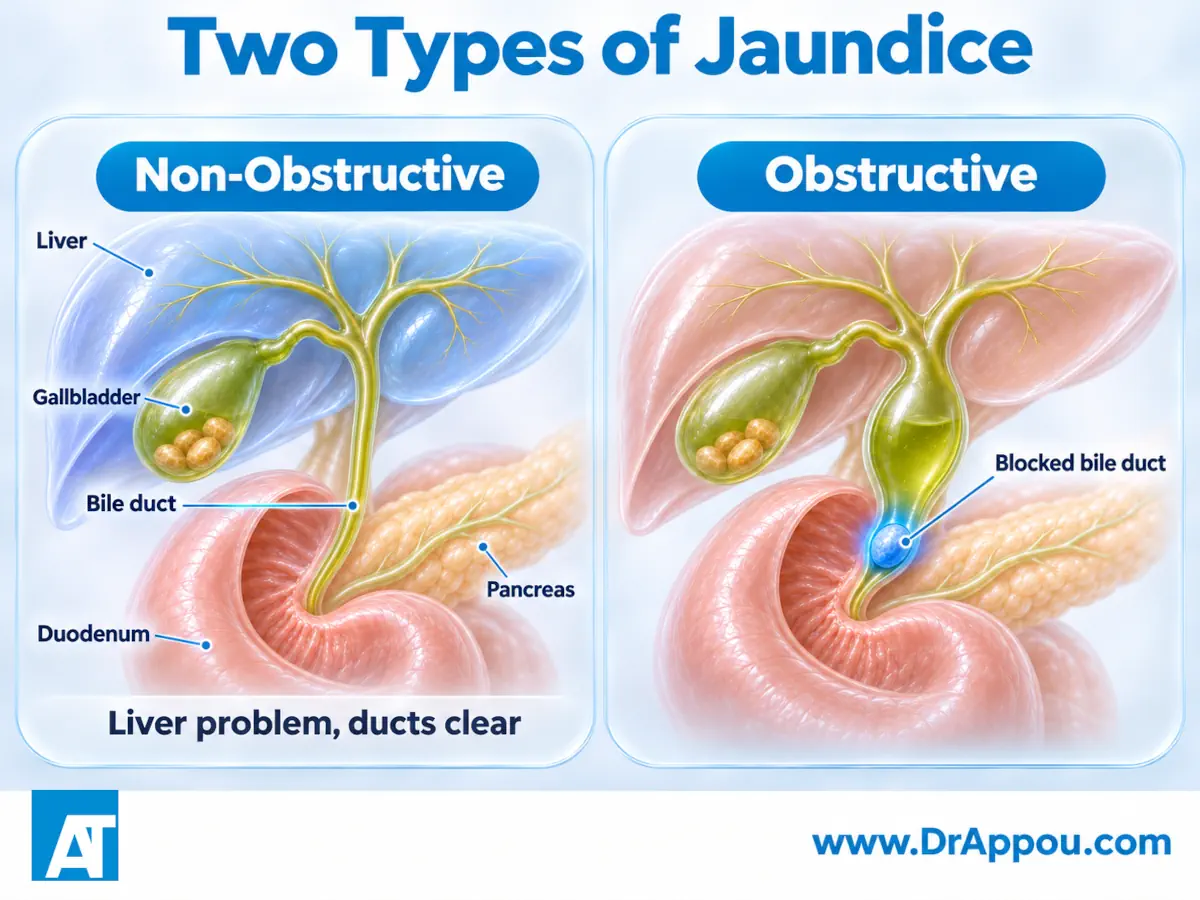
Jaundice develops when this process is disrupted at one of three points and the management of each is completely different. In practice, the question I am answering is simple: is something blocking the flow of bile, or not?
The earliest signs are often dark urine, pale stools and itching, which can appear before the eyes or skin turn yellow.
| Sign | What you may notice | What it suggests |
| Yellow whites of the eyes | Often the first visible change, easiest to see in daylight | Raised bilirubin from any cause |
| Yellow skin | A yellow tint to the face and body, harder to see on darker skin | Raised bilirubin from any cause |
| Dark urine | Tea or cola coloured, even when you are drinking normally | Bilirubin spilling into the urine, often from a liver or bile duct problem |
| Pale stools | Pale, grey or clay coloured | Bile is not reaching the bowel, which points to a blockage |
| Itching | Itching all over without a rash, often worse at night | Bile salts building up, common when bile cannot drain |
| General symptoms | Tiredness, nausea, poor appetite, weight loss or upper abdominal discomfort | Depends on the cause; important clues for your doctor |
Dark urine together with pale stools is a strong sign that bile is not reaching the bowel, and it should always be checked by a doctor. [1]
“Jaundice means someone developing yellowing of the white of the eyes and also passing yellow-coloured urine. Sometimes people may describe this as passing dark urine. Depending on the nature of the jaundice, some people have pale stools, particularly in what we call an obstructive jaundice. Patients with particularly deep jaundice may develop severe itching, and as a result, they’ll have lots of scratch marks on their skin.”
Dr. Appou Tamijmarane
Yes. Yellowing can be much harder to see on brown or black skin. The whites of the eyes are the most reliable place to look, ideally in natural daylight. [1] In my practice in Dubai, I also see early signs explained away as something else:
“Sometimes changing the white of the eyes into a yellow colour could be mistaken for a muddy conjunctiva, particularly for those who work outdoors and get used to working with dust. Passing dark-coloured urine can also happen if somebody is dehydrated. And sometimes people ignore jaundice associated with weight loss, and such patients should often seek urgent medical help.”
Dr. Appou Tamijmarane
If you notice dark urine, pale stools or itching, please have it checked, even if your skin colour looks normal.
It depends on the cause. Jaundice can appear within days when a gallstone suddenly blocks the bile duct or when the liver becomes acutely inflamed. It can also build up slowly over several weeks, for example when a bile duct gradually narrows. Jaundice that is getting deeper, or that comes with fever or new confusion, needs urgent assessment.
Eating large amounts of carrots, sweet potato, mango or other orange foods can give the skin a yellow-orange tint, especially on the palms. This is called carotenaemia and is harmless. The key difference is that it does not turn the whites of the eyes yellow. [4] If the whites of your eyes are yellow, see a doctor.
Jaundice with fever, confusion, severe abdominal pain, repeated vomiting, or bleeding or bruising needs emergency care the same day. New jaundice without these signs still needs a prompt medical assessment.
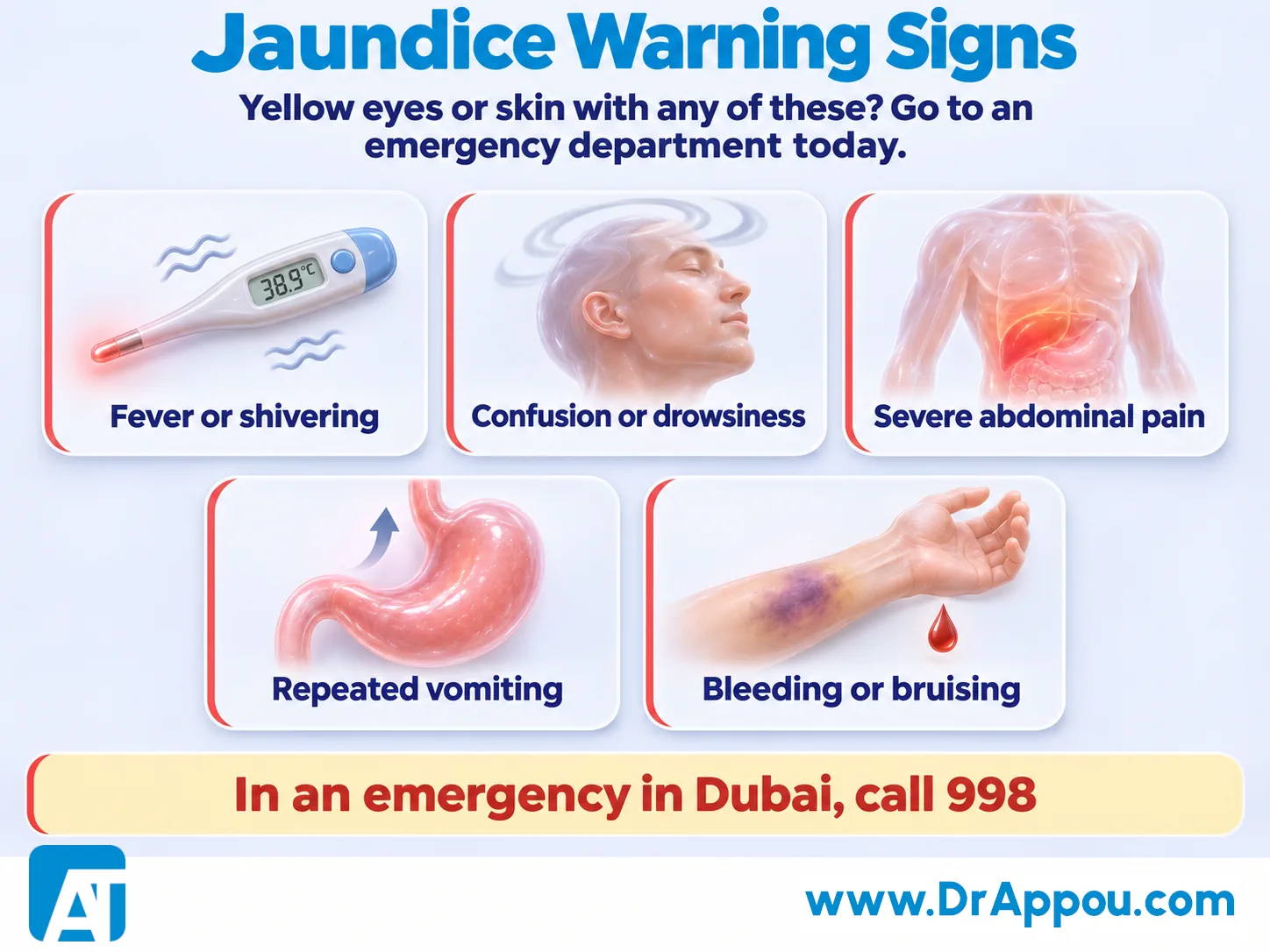
Go to an emergency department the same day if you have yellow eyes or skin together with any of the following:
These signs can mean an infected bile duct (acute cholangitis), pancreatitis, or a liver that is struggling to work. All need urgent hospital treatment. [5][6] In an emergency in Dubai, call 998 for an ambulance.
| Urgency | Typical situation | What to do |
| Emergency, today | Jaundice with any of the warning signs above, or feeling very unwell | Go to an emergency department, or call 998 |
| Urgent, within days | New yellow eyes or skin, dark urine, pale stools, persistent itching, weight loss, or jaundice that is slowly getting worse | See your GP or a specialist promptly for blood tests and a scan |
| Routine | Only after a doctor has assessed you and confirmed a harmless cause, such as Gilbert’s syndrome, with no warning signs | Follow the monitoring plan your doctor gives you |
Fever combined with jaundice is the point I want to emphasise most. When people wait, the jaundice can deepen, and pain and fever can follow:
“Fever, jaundice, and abdominal pain, particularly on the right side of the upper abdomen, almost always means you have an infection in the bile duct, termed as cholangitis.”
Dr. Appou Tamijmarane
A bile duct infection is not something to monitor at home. If you have jaundice and a fever, please seek urgent assessment the same day.
Jaundice in adults can start ‘before the liver’, ‘in the liver’, or ‘after the liver’ when a bile duct is blocked. The cause decides which specialist you need.
| Where the problem is | Examples | Typical clues | Usually assessed by |
| Before the liver | Faster breakdown of red blood cells (haemolysis), such as sickle cell disease or G6PD deficiency; Gilbert’s syndrome | Usually mild jaundice; tiredness or anaemia; normal coloured stools | Haematologist or general physician |
| In the liver | Viral hepatitis, alcohol-related liver disease, reactions to medicines or supplements, autoimmune liver disease | Tiredness, nausea, abnormal liver blood tests | Hepatologist or gastroenterologist |
| After the liver (a blocked bile duct) | Gallstones in the bile duct, narrowing of the bile duct, pancreatitis, bile duct cysts, tumours of the pancreas or bile duct | Dark urine, pale stools, itching; with or without pain | HPB surgeon and gastroenterologist |
“Jaundice may be due to gallstones in the bile duct, or a manifestation of cancer involving the bile duct or pancreas. In some cases it may be due to infection of the liver such as hepatitis, and of course there are various other causes for jaundice.”
Dr. Appou Tamijmarane
These groups are a guide only. Blood tests and a scan are needed to find the cause in each person. [1][4]
Yes. A gallstone can slip out of the gallbladder and lodge in the common bile duct, the main tube that carries bile to the bowel. This blocks the flow of bile and can cause jaundice, pain, infection or pancreatitis. [6] Stones in the bile duct usually need removing. Read more on the bile duct stones page.
Yes. The lower end of the bile duct passes through the head of the pancreas. Swelling from pancreatitis, a cyst, or a growth in the pancreas can press on the duct and stop bile draining. Gallstones are also a common cause of pancreatitis, so the two problems often go together.
Yes. A bile duct can narrow after inflammation, injury or earlier surgery, or because of a growth. Some people are born with a widened, cyst-like bile duct, called a choledochal cyst, which can cause jaundice at any age. These conditions are assessed and treated by an HPB surgeon.
Many cases of jaundice start in the liver itself, for example from viral hepatitis, alcohol, or a reaction to a medicine, herbal remedy or bodybuilding supplement. Others come from the blood, such as haemolysis or Gilbert’s syndrome, a common and harmless inherited condition that can cause mild jaundice during fasting, illness or stress. [1][3]
“If the jaundice is coming from the liver itself, a viral hepatitis, a reaction to medication, or liver disease, then the bile ducts are often normal, and what that patient needs is treatment of the underlying condition, not a procedure on the ducts. We support the liver, correct any clotting problems, and manage symptoms like the itching that jaundice causes. No endoscopy, no surgery.”
Dr. Appou Tamijmarane
These causes are usually treated by a hepatologist or gastroenterologist, and I work closely with them. Please bring a full list of your medicines and supplements to your appointment, and do not stop a prescribed medicine without medical advice.
Painful jaundice is often linked to gallstones, infection or inflammation. Painless jaundice that slowly gets worse needs prompt assessment, because a blockage of the bile duct or pancreas must be ruled out.
| Painful jaundice | Painless jaundice | |
| Common causes | Gallstones in the bile duct, an inflamed gallbladder, infection of the bile duct, pancreatitis | Narrowing of the bile duct, conditions of the pancreas or bile duct (including tumours), some liver conditions, Gilbert’s syndrome |
| How it often starts | Suddenly, with pain in the upper abdomen that may spread to the back or right shoulder | Gradually, sometimes noticed first by family, often with itching, dark urine or weight loss |
| Urgency | Emergency the same day if there is fever, severe pain or vomiting | Prompt assessment within days, sooner if it is getting worse |
Painless jaundice does not automatically mean cancer. Many non-cancerous conditions can block the bile duct without causing pain. [4] Even so, jaundice that is gradually getting worse, especially with weight loss, loss of appetite or new diabetes, should be investigated without delay. UK guidance recommends an urgent suspected-cancer referral for adults aged 40 and over with jaundice, so that the pancreas can be checked promptly. [2] This is a referral standard to make sure nothing is missed, not a diagnosis.
Pain alone cannot confirm the cause. Whether jaundice is painful or painless, the next step is the same: blood tests and a scan. The pattern I most want people not to ignore is jaundice that comes quietly, without pain, together with weight loss, that needs urgent medical help.
Doctors find the cause with a careful history, blood tests and an ultrasound scan, followed by more detailed scans when needed.
“We do not go straight to ERCP. We get an accurate diagnosis first, often starting with an ultrasound, but almost always progressing to an MRCP scan. Occasionally we may have to do a CT scan if the MRCP is not suitable.”
Dr. Appou Tamijmarane
| Test | What it shows | What it is like |
| Liver blood tests | Bilirubin level, and whether the pattern points to the liver or the bile ducts | A routine blood sample |
| Ultrasound | Gallstones, widened bile ducts, the liver and gallbladder | A painless scan with a probe on the abdomen, about 15 to 20 minutes |
| CT scan | Detailed images of the liver, pancreas and surrounding organs | A quick scan, usually with an injection of contrast dye |
| MRCP | A detailed map of the bile ducts and pancreatic duct, including small stones and narrowings | A specialised MRI scan with no radiation |
| Endoscopic ultrasound (EUS) | Close-up views of the lower bile duct and pancreas; a small tissue sample can be taken | A thin camera passed through the mouth under sedation |
A normal ultrasound is reassuring, but it does not always rule out a small stone in the lower bile duct or an early problem in the pancreas. If symptoms or blood tests still suggest a blockage, further scans are needed. [4]
ERCP (endoscopic retrograde cholangiopancreatography) is not usually used just to look. It is used to treat a blocked bile duct once the cause has been found, for example to remove a stone or place a stent. Read more in the article on ERCP for obstructive jaundice and bile duct stones.
The right specialist depends on the cause. Medical liver conditions such as hepatitis are treated by a hepatologist, while gallstones, a blocked bile duct, a pancreatic problem or a liver condition that may need surgery need an HPB surgeon.
| Cause | Usual specialist | Why |
| Severe symptoms or any warning sign | Emergency department | Same-day treatment, with specialists called in as needed |
| New jaundice, cause not yet known | GP, or a specialist directly | First blood tests and ultrasound to point to the cause |
| Hepatitis, alcohol-related or medicine-related liver injury, autoimmune liver disease | Hepatologist or gastroenterologist | Medical assessment and treatment of the liver |
| Haemolysis or another blood cause | Haematologist or general physician | Assessment of the red blood cells |
| Gallstones in the bile duct, a narrowed bile duct, a bile duct cyst | HPB surgeon, working with gastroenterology | Endoscopic and surgical treatment of the bile ducts and gallbladder |
| A suspected tumour of the pancreas, bile duct or ampulla | HPB surgeon within a multidisciplinary team, including oncology | Diagnosis, staging and a joint treatment plan |
“Where I get involved surgically is when the jaundice is caused by a blockage, something physically obstructing the flow of bile. The most common cause I see is a stone that has slipped out of the gallbladder and lodged in the common bile duct.”
Dr. Appou Tamijmarane
I am a Consultant General Surgeon with a focus on HPB (hepato-pancreato-biliary) surgery, and I perform ERCP and gallbladder and bile duct surgery myself. When the cause is a medical liver condition, such as hepatitis, I work with hepatologists, the physicians who treat liver disease with medicines. You can also read choosing the right HPB surgeon in Dubai.
Jaundice is treated by treating the source cause. For obstructive jaundice, symptoms usually settle once the blockage has been removed and the bile flows again.
The first priority is to treat any emergency, such as an infected bile duct. After that, treatment depends entirely on the cause.
“The honest answer to ‘what treatment do I need?’ is: it depends on what is causing the blockage, whether there is infection, and whether surgery is possible.”
Dr. Appou Tamijmarane
| Treatment | What it does | How it is done | May suit |
| ERCP | Removes stones from the bile duct or places a stent to let bile drain | A flexible camera through the mouth, under sedation or anaesthetic; no surgical cuts | Bile duct stones, urgent drainage of an infected duct, some narrowings and tumours |
| Laparoscopic bile duct exploration | Clears bile duct stones during gallbladder surgery, in a single operation | Keyhole surgery under general anaesthetic | Selected patients with bile duct stones who also need their gallbladder removed |
| Gallbladder removal (cholecystectomy) | Removes the gallbladder, where most stones form, to stop them coming back | Keyhole or robotic surgery under general anaesthetic | Most fit patients after gallstone-related jaundice |
| Biliary bypass (hepaticojejunostomy) | Creates a new route for bile to drain into the bowel | An operation under general anaesthetic | Some bile duct narrowings, bile duct cysts and bile duct injuries |
| Whipple procedure or other resection | Removes a tumour of the pancreas, bile duct or ampulla | Major surgery, planned by a multidisciplinary team | Selected patients after full staging |
| Medical treatment | Treats hepatitis, liver injury or blood causes | Medicines and monitoring, led by hepatology or haematology | Jaundice that starts in the liver or blood |
When a blockage cannot be removed, a stent may be placed during ERCP to let bile drain again. Patients often ask me what a stent is:
“Think of a stent as a small hollow straw that is placed inside the duct to support the duct walls, allowing the body fluids to flow freely again, relieving your symptoms. Stents are made of plastic or metal, and the choice of material is based on the anticipated time frame of use. If over 3 to 6 months, then metal is the first choice.”
Dr. Appou Tamijmarane
While you are being assessed, avoid alcohol and any herbal remedies or supplements that have not been prescribed. So-called liver detox products are not a treatment for jaundice.
Your first appointment reviews your symptoms and any tests so far, checks for warning signs, and ends with a clear plan for the next step.
“When the patient comes with the history of jaundice to my clinic, I take a detailed history and examine the patient, and arrange very specific investigations, including blood tests and scans. The advantage of going to a specialist is that you get a very clear understanding of the pathway of managing jaundice, depending on the cause of the jaundice and what could happen, and what would be the outcome from the various management options.”
Dr. Appou Tamijmarane
In practice, that usually means:
For referring doctors
Send for same-day emergency assessment if you suspect cholangitis (jaundice with fever or rigors and right upper quadrant pain), acute liver failure (confusion, drowsiness, coagulopathy), severe pancreatitis, or if the patient is systemically unwell. [5][7]
Refer urgently for painless progressive jaundice, jaundice with weight loss, a cholestatic liver blood test pattern, or a dilated bile duct on ultrasound. UK guidance recommends a suspected-cancer pathway referral for adults aged 40 and over with jaundice. [2]
Helpful information to include:
I welcome direct referrals from GPs across Dubai for suspected biliary obstruction, bile duct stones and pancreatic or bile duct or liver conditions.
I see patients at Fakeeh University Hospital, Dubai Silicon Oasis, face to face or online, in English or Tamil.
Fakeeh University Hospital is in Dubai Silicon Oasis, close to Academic City, International City, Mirdif and Dubailand. A translator can be arranged for other languages, and free parking is available.
To book a consultation, use the Okadoc booking system or call the Fakeeh University Hospital booking line on +971 4 414 4444. If you would like to speak with me before booking, you can message me on WhatsApp.
In summary
References
The figures on this page are drawn from international clinical guidelines and peer-reviewed studies, listed in the references above. They describe results reported in published research; your own risks and options will be discussed with you at your consultation.
What is jaundice? · Early signs · When it is an emergency · Causes · Painful or painless · Tests and diagnosis · Which specialist · Treatment options · Your appointment · For GPs · Where to be assessed · FAQs
Medical Disclaimer
This page is for general education and does not replace medical advice, diagnosis or treatment. If you have jaundice with any of the warning signs on this page, or you are pregnant and develop jaundice, seek medical care promptly. Dr. Appou Tamijmarane is licensed by the Dubai Health Authority (DHA License No: 50530660-001) and practises as a Consultant General Surgeon at Fakeeh University Hospital, Dubai Silicon Oasis, UAE.