
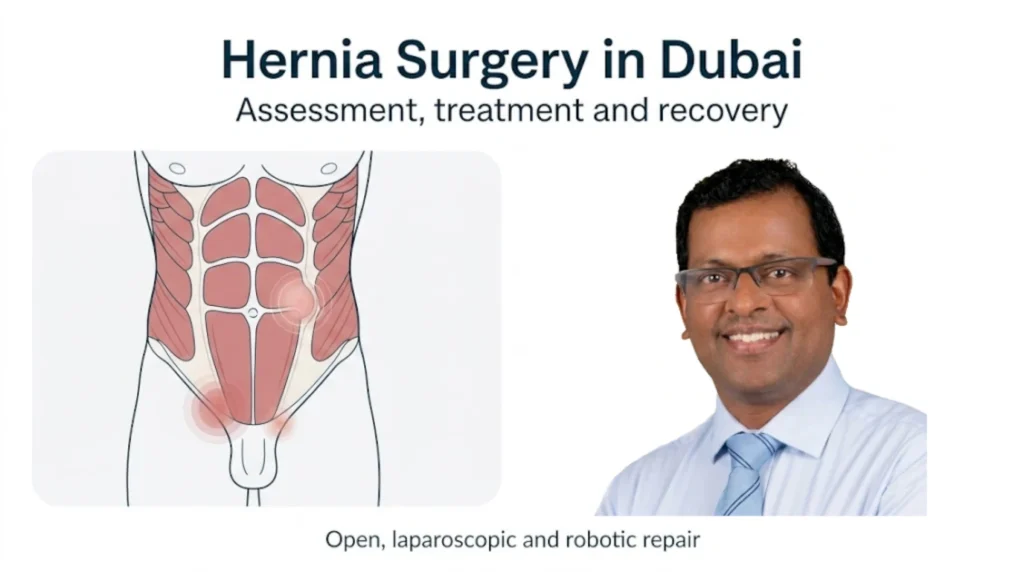
Your complete guide to hernia surgery from a UK-trained Consultant General Surgeon with 35+ years of experience, now practicing at Fakeeh University Hospital, Dubai Silicon Oasis.
By Dr. Appou Tamijmarane | MS, FRCS (Edinburgh), FRCS (Glasgow)
Consultant General Surgeon specializing in HPB, Upper GI, and Advanced Laparoscopic Surgery
Fakeeh University Hospital, Dubai Silicon Oasis | DHA License No: 50530660-001
Published: July 2026 | Last reviewed: July 2026 | Reading time: 20 minutes
Written for patients in Dubai considering hernia surgery or seeking a diagnosis. Dr. Appou Tamijmarane, Consultant General Surgeon, explains the full picture, in his own words.
What is a hernia? · Symptoms · Diagnosis · Do I need surgery? · Types of hernia · Surgical options · Dr. Appou’s experience · Risks and recurrence · Emergency warning signs · Where to be treated · Cost and insurance · FAQs
Key Takeaways
Most hernias can be repaired safely through open, laparoscopic, or robotic surgery, but the right approach depends on the hernia type, symptoms, previous operations, and your overall health.
Hernia is one of the most common surgical conditions I treat. Across more than 35 years of surgical practice, including 18 years as an NHS Consultant at Raigmore Hospital in Inverness, a regional tertiary center serving 320,000 people across the Highlands of Scotland, and my current practice at Fakeeh University Hospital in Dubai Silicon Oasis, I have performed hundreds of hernia repairs. These have ranged from straightforward first-time inguinal hernias to complex recurrent cases where a previous repair has failed, to large ventral and incisional hernias requiring abdominal wall reconstruction.
Hernias vary widely: from small, painless swellings that can be safely monitored, to painful, irreducible hernias requiring emergency surgery. The right treatment depends on the hernia type, its symptoms, the risk of obstruction, and your overall health. In this guide, I explain how I assess a hernia, when I recommend surgery, how I choose between laparoscopic, robotic, and open repair, and what patients can expect before and after treatment. I also link to detailed pages covering each major type of hernia and treatment option.
You can read more about my background, training, and approach on my About page.
On this page
A hernia occurs when an organ or section of fatty tissue pushes through a weak point or gap in the surrounding muscle or connective tissue. In the abdomen and groin, the areas I see most often, the defect may be present from birth, develop gradually with age, or appear following surgery or injury.
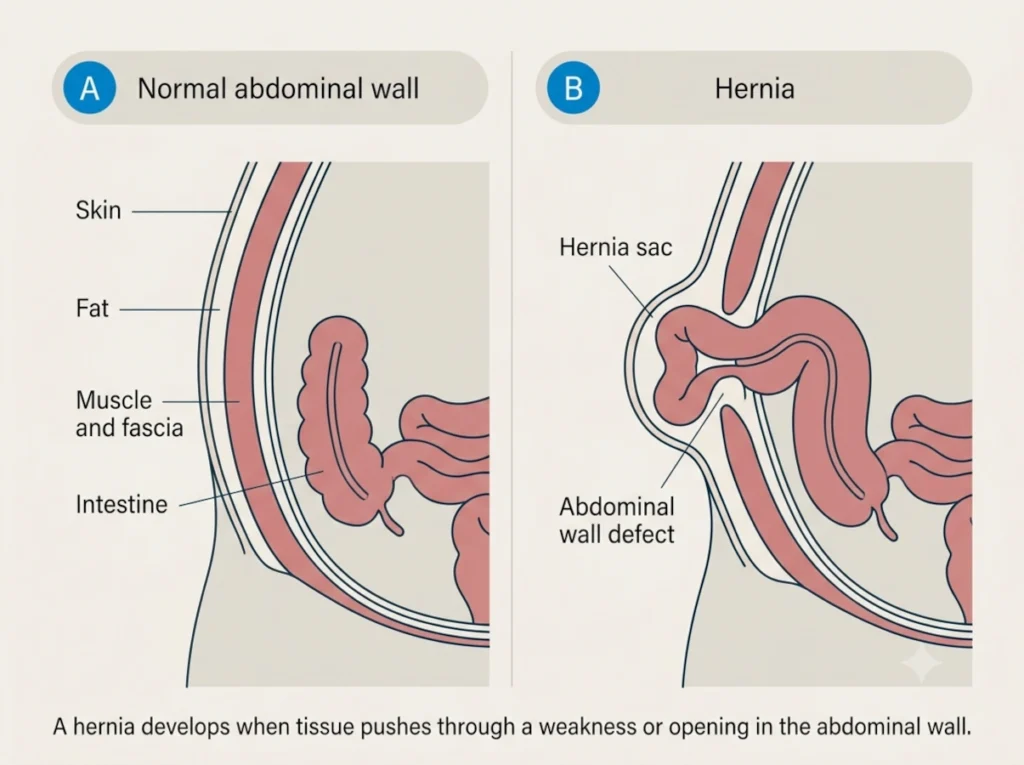
Hernias vary considerably in type, size, location, and urgency. Some are discovered incidentally on a scan and cause no symptoms at all. Others present suddenly with pain and cannot be pushed back in, which requires emergency surgery. Most fall somewhere between these extremes: noticeable, intermittently uncomfortable, and gradually enlarging over months or years.
For patients with very small asymptomatic hernias who are not fit or ready for surgery, conservative measures including weight management and, in some cases, a hernia truss or support belt can allow comfortable daily life. A truss does not repair a hernia and should only be used after clinical assessment. For optimal support, it must be fitted and used correctly, it should not be applied over a painful or irreducible hernia, and it can occasionally cause pressure or skin irritation with prolonged use. Any worsening symptoms require urgent reassessment rather than continued reliance on a truss. For some patients with a ventral hernia, general core conditioning may be discussed as part of overall fitness, though it will not close or heal the hernia defect itself. This approach is only appropriate when the hernia is genuinely asymptomatic and reducible, meaning it can be pushed back in. Understanding which type of hernia you have, and what that means for your management, is the starting point for every consultation I have with a hernia patient.
The most common symptom is a visible or palpable lump, often with discomfort or heaviness when standing, coughing, or straining, and an ache that builds after activity. Many hernias reduce, meaning the bulge disappears or softens when lying down. Severe pain, vomiting, or a lump that cannot be pushed back in are different, and are covered separately below under emergency symptoms.
Most hernias are diagnosed through clinical examination alone. Ultrasound or CT imaging may be used when the diagnosis is uncertain, symptoms do not fully match the examination, or for surgical planning in complex, recurrent, or incisional hernias. As explained above, not every abdominal symptom is caused by the hernia itself, so further tests are sometimes needed to check for other contributing problems before confirming the surgical plan.
Not every hernia needs immediate surgery. Small, reducible, asymptomatic hernias can sometimes be monitored, especially where surgery carries higher risk for that patient. Hernias that are painful, enlarging, difficult to reduce, femoral, obstructed, or strangulated usually need surgical repair.
When a patient sits down in front of me with a confirmed hernia, I do not start by talking about the operation. Before I recommend anything, I work through six clinical questions in my mind. This is the same framework I have used across more than three decades of surgical practice, and it is what determines whether surgery is the right option for you.
The six questions I consider before recommending hernia surgery
Only after I have carefully worked through each of these factors do I offer a definitive opinion on how to manage the hernia. The decision on how to move forward then comes through discussion with you and, if you wish, your family, because other factors such as your work schedule and the support you will have after the operation all play a role in whether elective surgery is the right choice for you now or later.
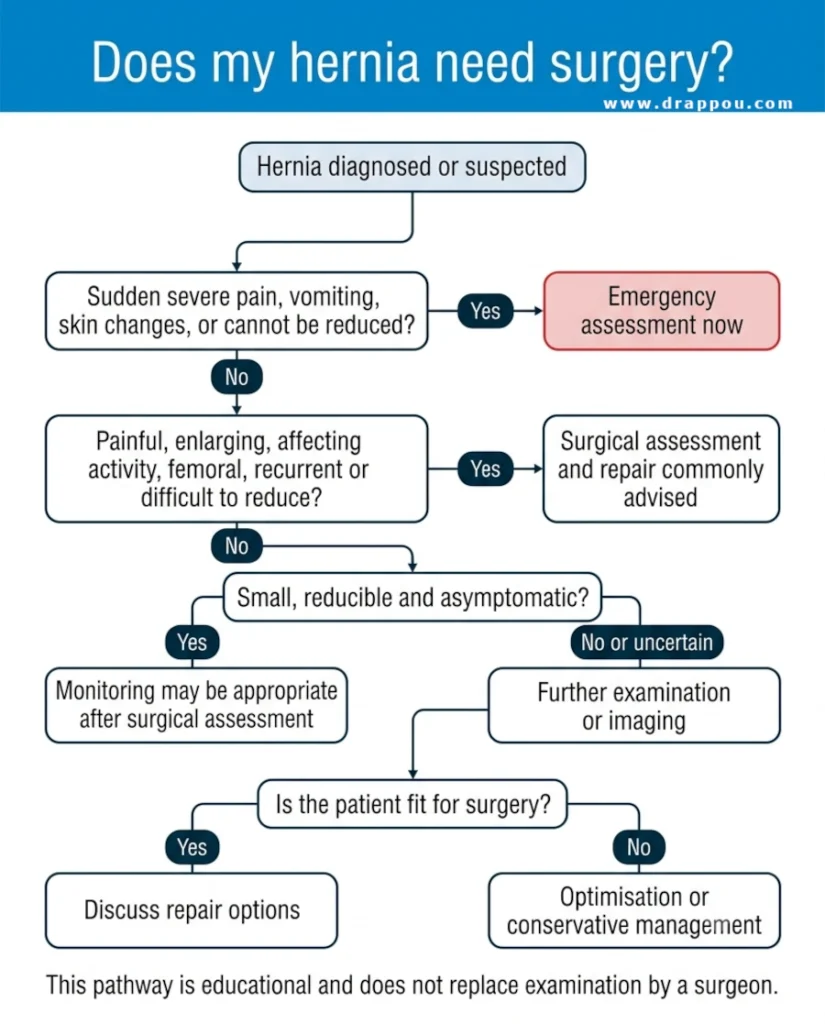
Even when a hernia is confirmed, surgery is not always the right solution. For patients who are very elderly, frail, or living with multiple other medical conditions, putting them through an anesthetic and an operation may cause more harm than the hernia itself. In those situations, it is more prudent to follow conservative management, which may include wearing a hernia truss to support the hernia in place. If the patient’s overall condition can be improved, then we can reconsider surgery at a later stage to make it safer. For any patient not undergoing surgery, my advice is always the same: if your symptoms worsen, seek medical advice for reassessment straight away.
There is sometimes a genuine mismatch between what a patient expects and what I recommend. A patient may arrive expecting me to operate, and I advise watching and waiting instead, particularly when the hernia is small and causing no symptoms at all. Of course, even small hernias can occasionally obstruct, with a risk of strangulation, so the defect must be carefully assessed by both clinical examination and scans before I reach that conclusion. Once I am satisfied a hernia is asymptomatic and unlikely to cause problems, especially in a patient with multiple other health conditions, watching and waiting is often the safer choice. Sometimes I choose not to operate at the first consultation, but instead work to optimize the patient so surgery becomes safer later. This takes a careful conversation, and some effort to build trust, to help a patient understand that having surgery is not always in their best interest.
What is a hernia? · Symptoms · Diagnosis · Do I need surgery? · Types of hernia · Surgical options · Dr. Appou’s experience · Risks and recurrence · Emergency warning signs · Where to be treated · Cost and insurance · FAQs
The most common misconception I correct
When patients come to me with symptoms they assume are caused by their hernia, I often explain that the hernia may not be the only contributing factor to their symptoms. Sometimes we need detailed scans and specific blood tests to check whether there is another problem in addition to the hernia. Once we have ruled out anything else, the hernia is then addressed for definitive management.
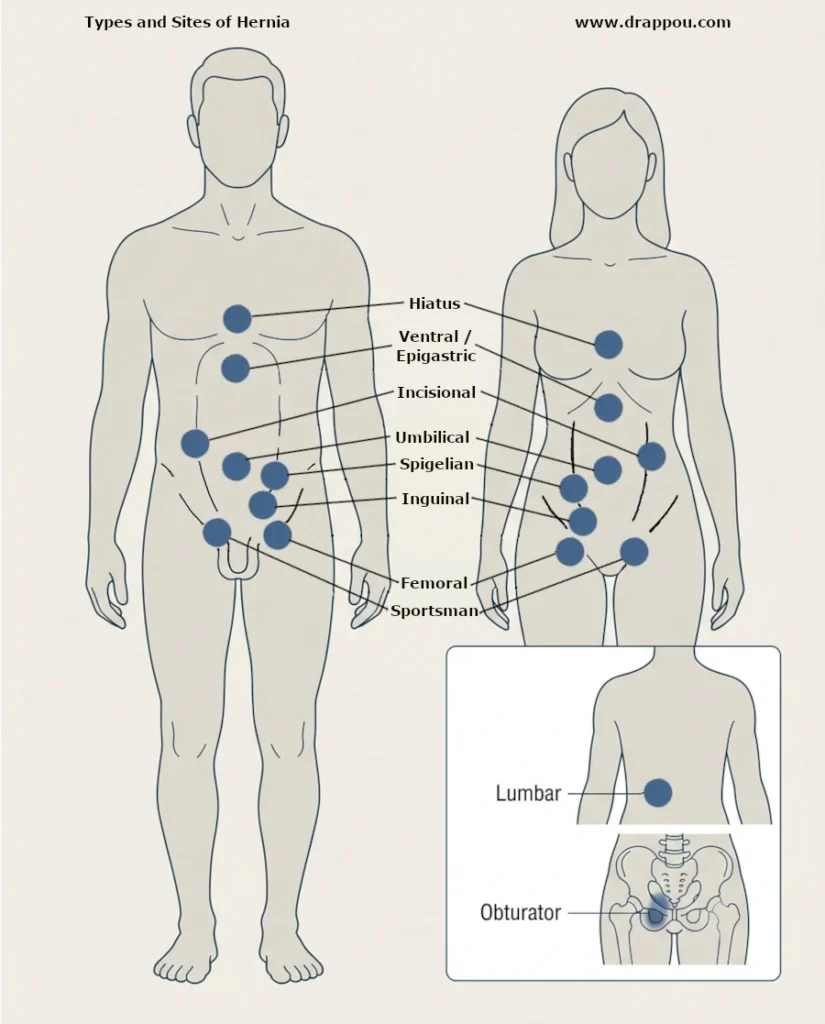
These are the hernia types I treat. Each has its own anatomical location, typical presentation, and surgical considerations. Use the links below to read a dedicated page on your specific hernia type.
The right hernia operation depends on the hernia type, size, symptoms, previous surgery, anatomy, and overall fitness for anesthesia. Laparoscopic repair is suitable for many elective first-time inguinal hernias. Open repair may be preferable in emergencies or when a general anesthetic is unsuitable, while robotic surgery can offer advantages in selected complex, recurrent, or abdominal-wall repairs.
There is no single correct technique for every hernia. The right operation depends on the type and size of your hernia, your anatomy, your previous surgical history, your overall health, and in some cases your own informed preference. I discuss all of this openly at the first consultation.
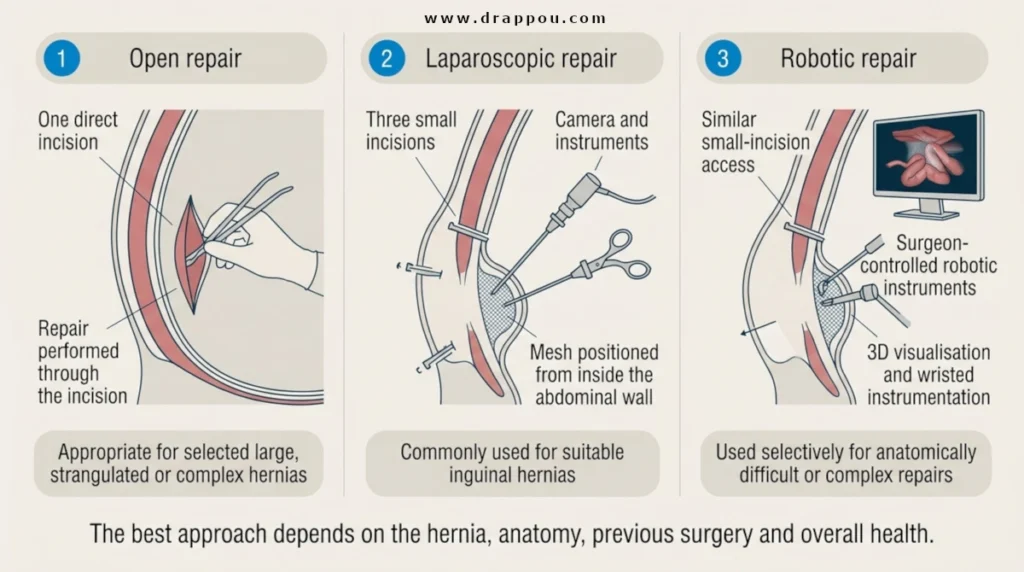
Choosing between open, laparoscopic, or robotic pathways is a case-by-case decision. Many straightforward first-time inguinal hernias are suitable for minimally invasive repair. In my practice, laparoscopic repair is commonly used for these cases, while robotic surgery is selected when its technical capabilities offer a meaningful advantage. Any factor that increases the difficulty of the operation must be taken into account. I more commonly use open surgery in emergency situations such as strangulation, when a patient cannot have a general anesthetic and a spinal block is used, when access is difficult because of altered anatomy from previous abdominal surgery, or when the hernia defect is very large. In those last two situations, a robotic approach can sometimes be advantageous instead. Robotic surgery is also useful in patients with obesity, or where the hernia sits close to bone or nerve bundles. Every patient is fully assessed, and I discuss my surgical recommendations with them directly. Patients interested in the technology behind robotic-assisted procedures can also read Dr. Appou’s article on robotic hernia repair in Dubai.
| Approach | Best suited for | Typical recovery to desk work | Key differentiator |
| Laparoscopic TAPP | Most first-time inguinal hernias; Dr. Appou’s preferred approach | 5 to 10 days | Clear, consistent operative view and precise mesh positioning |
| Robotic repair | Selected patients with obesity, hernias near bone or nerve bundles, and some complex or recurrent cases | 5 to 10 days | Enhanced 3D visualization and wristed suturing; used selectively |
| Open mesh repair | Strangulation, large defects, altered anatomy from prior surgery, spinal block cases | 2 to 3 weeks | Not an older technique; the right choice for specific complex cases |
| Suture-only repair | Patients who decline mesh after full discussion | 2 to 3 weeks | Higher recurrence than mesh repair in published series; rarely recommended |
**Recovery times shown above are typical ranges and vary from patient to patient depending on age, general health, the complexity of the hernia, and whether any complication occurs. Your surgeon will give you guidance specific to your situation.
Read a dedicated page on each treatment option below.
What is a hernia? · Symptoms · Diagnosis · Do I need surgery? · Types of hernia · Surgical options · Dr. Appou’s experience · Risks and recurrence · Emergency warning signs · Where to be treated · Cost and insurance · FAQs
Patients considering hernia surgery reasonably want to know not just what the operation involves, but who will be performing it and what their outcomes look like. I am transparent about the following.
For inguinal hernia repair, my personal recurrence rate has been approximately 1 to 2% over my years in practice. Patient-related factors (obesity, diabetes, smoking, large defect size, and weakened connective tissue) affect biological recurrence risk regardless of technique. On the technical side, recurrence is most commonly driven by inadequate mesh coverage, poor fixation, or a mismatch between technique and anatomy. In selected complex cases, I prefer TAPP because the transabdominal view allows me to assess the anatomy directly and position the mesh under clear visual control. TEP is an established technique and remains an effective option for the selected patients where it is the better fit.
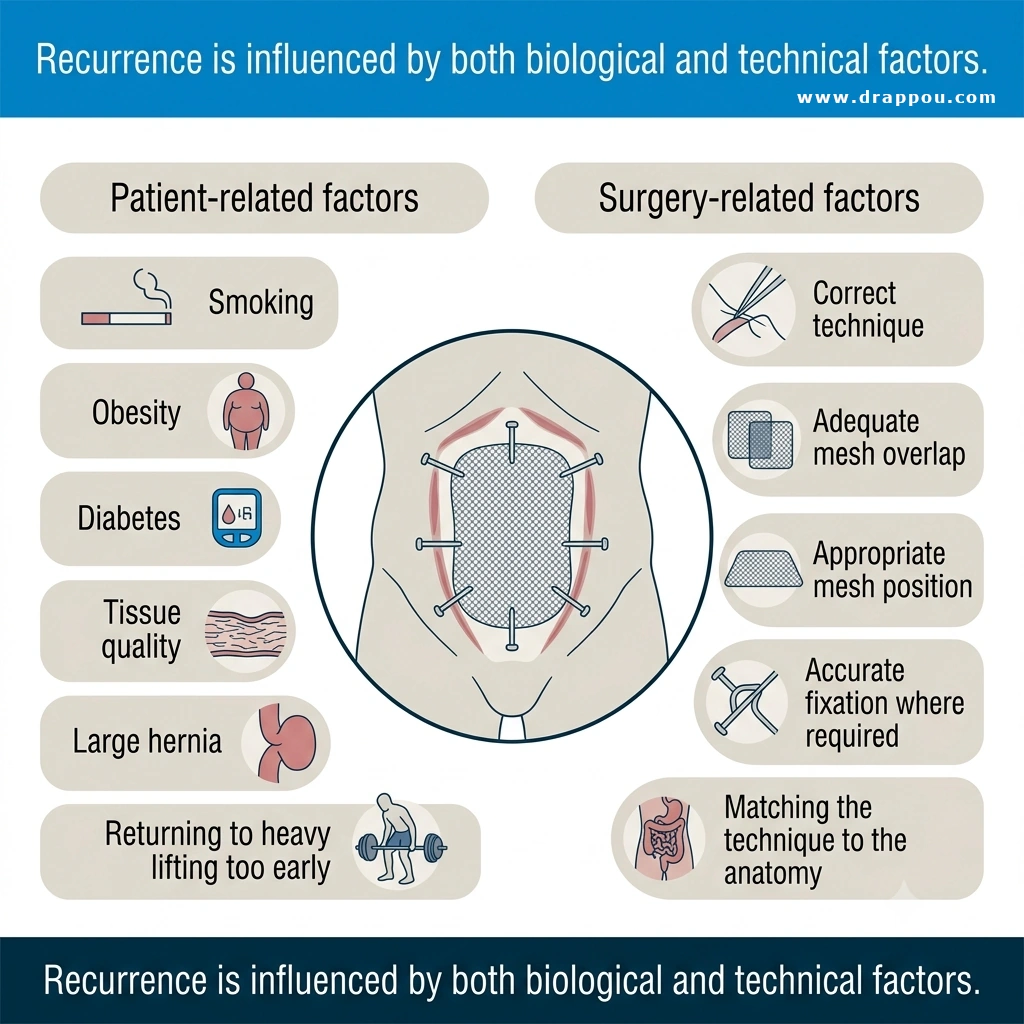
For primary inguinal hernia repair, modern mesh-based techniques generally produce substantially lower recurrence rates than non-mesh repair. Published recurrence rates vary according to technique, follow-up period, defect size, and patient factors (HerniaSurge International Guidelines, 2018). For patients who have specific concerns about synthetic material, I will discuss suture repair openly, but I will always explain the trade-off clearly.
Repairing a hernia that has recurred after a previous operation is considerably more demanding than a first repair. The surrounding tissue is scarred, the anatomy is distorted, and the original mesh has usually incorporated into the surrounding tissue. Occasionally, if there is an infection, the mesh may need to be removed when possible. I will tell patients honestly what is involved and what the risks are, and will choose the surgical approach, whether laparoscopic or open, based on what the anatomy allows safely, not on what is easiest.
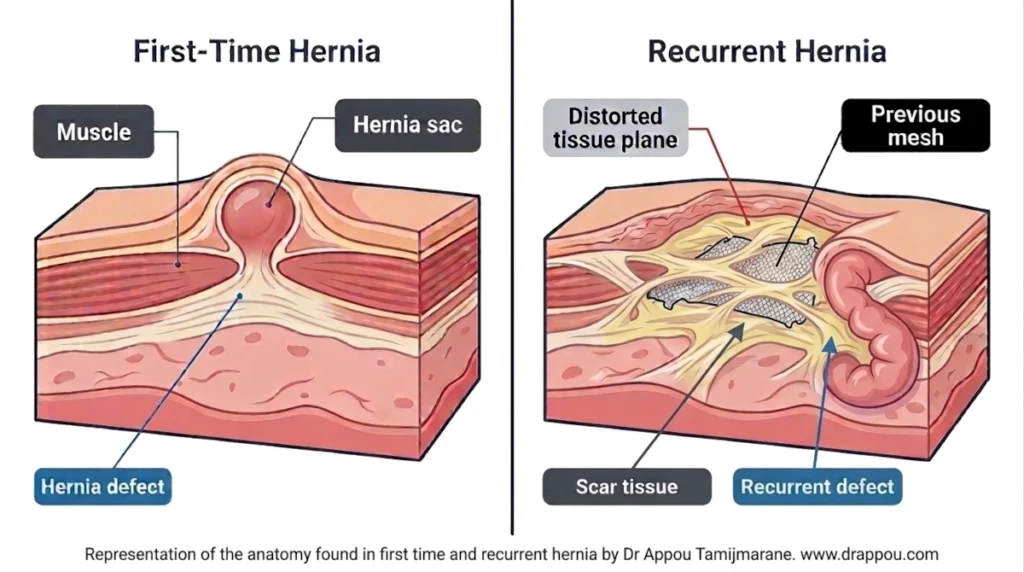
I perform laparoscopic TAPP and TEP repair, open mesh repair, robotic-assisted repair, and complex abdominal wall reconstruction. I have undertaken specific training in hernia surgery across my career, including cadaveric abdominal wall reconstruction training in Bristol, laparoscopic TAPP courses at Edinburgh, Hexham, and NUGITS, and management of the full hernia surgical workload of a regional NHS tertiary center over 18 years. You can read patient testimonials from patients I have treated in Scotland and Dubai.
I was awarded the Norman Tanner Medal and Travelling Fellowship by the Royal Society of Medicine, London, in 2002, for the best presentation on the anterior approach to right hepatectomy (liver resection). While this recognition relates to hepatobiliary surgery rather than hernia surgery specifically, it reflects the same rigorous surgical training and technique I bring to complex cases across my practice.
I consult and operate in English and Tamil. You can verify my DHA license on the DHA Sheryan portal (License No: 50530660-001).
What is a hernia? · Symptoms · Diagnosis · Do I need surgery? · Types of hernia · Surgical options · Dr. Appou’s experience · Risks and recurrence · Emergency warning signs · Where to be treated · Cost and insurance · FAQs
As with any operation, hernia surgery carries some risk, and I discuss these openly with every patient before surgery as part of informed consent. General risks include bleeding, infection, a build-up of fluid at the wound site (a seroma), and chronic pain or numbness at the repair site, which is more often associated with groin hernia repair. Recurrence, discussed above, is also a recognized risk of any hernia repair. Some patients experience discomfort related to the mesh itself, though this is uncommon with correct technique and mesh selection.
Risk is not the same for every patient. It is generally higher in emergency surgery, in patients with obesity, diabetes, or a smoking history, and in recurrent or complex repairs. I discuss your individual risk profile at consultation, based on your specific hernia and health history, so you can make an informed decision.
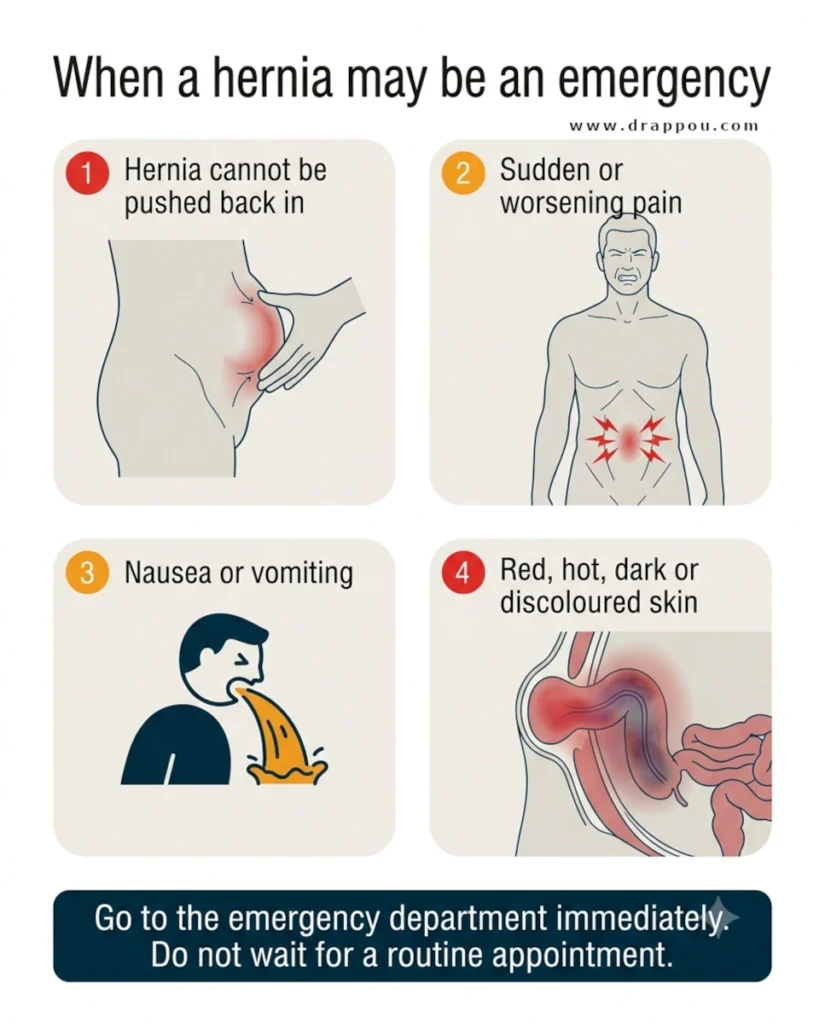
A hernia may be an emergency if the lump cannot be pushed back in, becomes suddenly painful, causes nausea or vomiting, or the skin over the hernia becomes red, hot, or discolored. These signs may indicate obstruction or strangulation and require urgent surgical assessment.
Go to the emergency department immediately. Do not wait for a routine appointment. Warning signs include any of the following:
These signs may indicate an obstructed or strangulated hernia, where trapped tissue is losing its blood supply. Emergency hernia surgery carries significantly higher risk than planned elective repair, including greater likelihood of infection, bleeding, open surgery, and in the most serious cases, bowel resection. If in doubt, seek urgent surgical advice.
What is a hernia? · Symptoms · Diagnosis · Do I need surgery? · Types of hernia · Surgical options · Dr. Appou’s experience · Risks and recurrence · Emergency warning signs · Where to be treated · Cost and insurance · FAQs
I perform both elective and emergency hernia surgery at Fakeeh University Hospital, a 350-bed tertiary care hospital in Dubai Silicon Oasis and the first hospital in the UAE to achieve HIMSS EMRAM Stage 7 accreditation, the highest international benchmark for digital healthcare and electronic medical records. FUH provides access to laparoscopic and robotic surgical platforms, advanced pre-operative imaging including CT and ultrasound, and dedicated surgical nursing teams.
For patients across south-east Dubai (DSO, Dubailand, Academic City, Mirdif, Nad Al Sheba, Mudon, Villanova, The Villa and Arabian Ranches) FUH is directly accessible by car with free parking onsite.
The cost of hernia surgery depends on several factors rather than a single fixed price: the type of hernia, whether the repair is open, laparoscopic, or robotic, whether it is unilateral or bilateral (on one side or both sides of the abdomen), whether it is a primary or recurrent repair, and whether the procedure is day surgery or requires an overnight stay.
Hernia surgery at FUH is covered by a wide range of insurance providers, with over 480 supported plans across the major administrator networks including NEXTCARE, NAS, Neuron, MEDNET, and Al Madallah. This includes plans from insurers such as Daman, AXA Gulf, Cigna, ADNIC, Bupa Global, and Allianz. Coverage and pre-authorization requirements vary by policy, network, and the specific procedure planned. To confirm whether your plan is covered, check the up-to-date insurance list on the Okadoc booking page, or confirm current eligibility directly with the FUH insurance desk before treatment. For patients paying directly, a detailed cost estimate is provided following your initial consultation once the appropriate surgical approach has been confirmed. The right operation for your hernia is the starting point for any accurate cost discussion.
To book a consultation, use the FUH’s live booking system, Okadoc or message Dr. Appou via WhatsApp.
In summary
What is a hernia? · Symptoms · Diagnosis · Do I need surgery? · Types of hernia · Surgical options · Dr. Appou’s experience · Risks and recurrence · Emergency warning signs · Where to be treated · Cost and insurance · FAQs
References
What is a hernia? · Symptoms · Diagnosis · Do I need surgery? · Types of hernia · Surgical options · Dr. Appou’s experience · Risks and recurrence · Emergency warning signs · Where to be treated · Cost and insurance · FAQs
Medical Disclaimer
This page is written for general educational purposes and does not constitute medical advice, diagnosis, or treatment. Individual surgical decisions must be made in consultation with a qualified healthcare professional following full clinical assessment. If you are experiencing symptoms described on this page, including any signs of hernia obstruction or strangulation, please seek medical attention promptly. Dr. Appou Tamijmarane is licensed by the Dubai Health Authority (DHA License No: 50530660-001) and practices as a Consultant General Surgeon at Fakeeh University Hospital, Dubai Silicon Oasis, UAE.
Chat