
22 October 2025
By Dr. Appou Tamijmarane | MS, FRCS (Edinburgh), FRCS (Glasgow)
Consultant General Surgeon specializing in HPB, Upper GI, and Advanced Laparoscopic Surgery
Fakeeh University Hospital, Dubai Silicon Oasis | DHA License No: 50530660-001
Published: October 2025 | Last reviewed: July 2026 | Reading time: 8 minutes
Written for patients in Dubai considering robotic hernia repair. Dr. Appou Tamijmarane, Consultant General Surgeon, explains his own thinking, in his own words.
Robotic hernia repair in Dubai is a minimally invasive hernia surgery option where the surgeon controls robotic instruments through a console. In Dr. Appou Tamijmarane’s practice at Fakeeh University Hospital, Dubai Silicon Oasis, robotic repair is considered alongside laparoscopic and open surgery, with the final approach chosen based on hernia type, previous surgery, adhesions, patient fitness, surgical safety and patient choice.
Why I started · What changed · What patients misunderstand · When it’s useful · When I don’t recommend it · How I decide · Where it’s heading · Questions to ask · FAQs
Key Takeaways
Robotic hernia repair at Fakeeh University Hospital, Dubai Silicon Oasis is one option Dr. Appou Tamijmarane, Consultant Surgeon (MS, FRCS Edinburgh, FRCS Glasgow), offers alongside laparoscopic and open surgery, chosen case by case.
When patients ask me about robotic hernia repair, the first thing I explain is that the robot does not perform the operation. I do. Over more than 35 years of surgical practice, including 18 years as an NHS Consultant in Scotland and my current practice as a Consultant General Surgeon at Fakeeh University Hospital, Dubai Silicon Oasis, I have built my experience in hernia surgery across open, laparoscopic, and now robotic-assisted techniques. Robotic surgery is a tool I use selectively, not a technology I promote for its own sake. This article sets out what I actually tell patients when they ask about it, including when I think it helps, and when I do not recommend it.
If you want the fuller picture of hernia types, symptoms, and treatment options, my hernia hub page covers open, laparoscopic, and robotic repair in more detail, alongside emergency warning signs and recovery guidance. This article focuses specifically on how I think about robotic hernia repair in my own practice. You can also read more about my training and background on my About page.
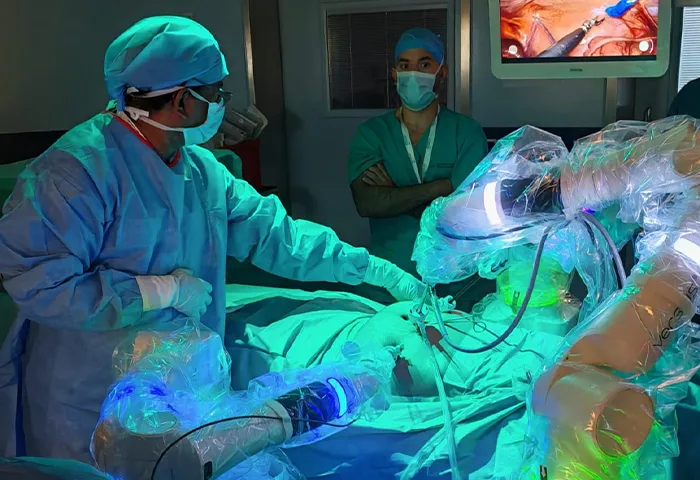
Robotic hernia repair was, for me, an inevitable progression from laparoscopic surgery rather than a new direction. The underlying principles are the same: keyhole access, careful dissection, and precise mesh placement to repair the hernia defect. What changes with the robotic platform is how that work gets done. Robotic hernia repair makes certain technical steps easier and more ergonomic for the surgeon, and in my experience, complex hernias can sometimes be managed more comfortably with robotic assistance than with standard laparoscopic instruments. At Fakeeh University Hospital, Dubai Silicon Oasis, I have access to robotic surgical platforms alongside laparoscopic and open options, and I choose between them based on the individual patient, not a fixed preference for one technology.
The most meaningful difference is visualisation and control. Robotic platforms give me a three-dimensional surgical field, where I can differentiate tissue planes more precisely than with the two-dimensional view used in standard laparoscopic surgery. This matters most when I am suturing in awkward or confined spaces within the abdomen, where robotic instruments give me an advantage over laparoscopic ones. I want to be clear that this does not make robotic surgery automatically better for every hernia. For straightforward, first-time hernias, laparoscopic repair remains an effective, well-established option. Where robotic repair tends to help most is in cases where precise dissection and mesh placement are more technically demanding, and that is something I assess with each patient individually before recommending an approach.
The most common misunderstanding I hear is that the robot performs the operation instead of me. It does not. During robotic hernia repair, I control every instrument movement from the console throughout. The robotic system does not decide, cut, stitch, or repair anything on its own; it functions as a tool that extends my own hands with greater precision. I explain this directly to patients because it affects how comfortable they feel about the operation. Once patients understand that I remain in full control throughout, and that the robotic platform simply gives me a better view and steadier instruments, most of the anxiety around “robotic surgery” resolves.
Robotic hernia repair may be suitable for many hernia patients, and there are relatively few absolute contraindications, but suitability always depends on the hernia type, previous operations, adhesions, anatomy, and the safest route of access. In my practice, I have found it particularly useful for hernias associated with obesity, and for hernias located close to bone or nerve bundles, where precision matters more than usual. Larger hernia defects can also sometimes be managed well robotically. In patients with obesity, or when the hernia lies close to important structures such as bone or nerve bundles, the ability to work with a stable three-dimensional view and fine instrument control can genuinely help. This does not mean robotic repair is automatically required in those cases, but it can influence my decision when precision is especially important. I assess each of these factors before recommending robotic repair, laparoscopic repair, or an open approach, rather than defaulting to one technique for every patient who walks into my clinic.
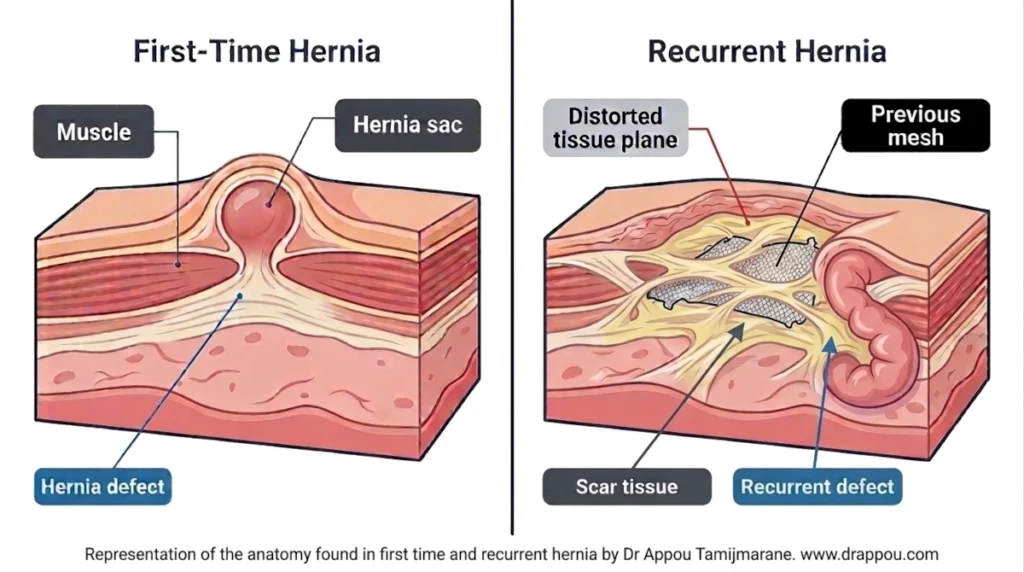
Patients sometimes expect robotic surgery to be the right answer for every hernia, and I do not see it that way. If a patient has had multiple previous abdominal operations and I expect extensive adhesions inside the abdomen, I generally avoid both robotic and laparoscopic surgery, because gaining access to the peritoneal cavity carries an increased risk of injury to the bowel in that situation. I also do not routinely recommend laparoscopic or robotic surgery for large inguinoscrotal hernias, where I prefer an open approach. Other surgeons may reasonably make different choices in similar cases; this reflects my own clinical judgement, based on my own experience managing complex and recurrent hernias over more than three decades.
In my practice, robotic repair may not be the safest first choice when:
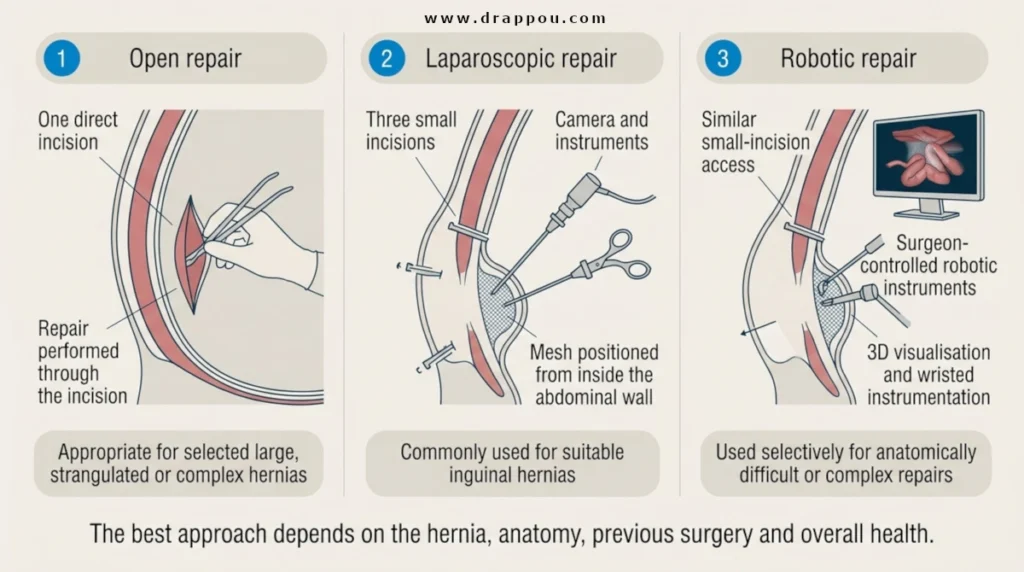
For a simple, first-time hernia, laparoscopic or robotic repair is usually my starting point, because both offer a shorter recovery than open surgery. Certain factors shift that decision toward open surgery: an emergency strangulated hernia, a patient who cannot tolerate general anaesthesia and needs a spinal block instead, altered anatomy from previous abdominal surgery, or a very large hernia defect. In some of these same situations, particularly large defects or difficult anatomy, a robotic approach can also work well and sometimes becomes my preferred option instead of open surgery. Every patient is fully assessed before I make a recommendation, and I discuss that reasoning with them directly rather than presenting a single default plan.
| Approach | When it may be considered | Why |
| Robotic repair | Selected complex, recurrent, larger, or technically demanding hernias | Three-dimensional visualisation and precise instrument control in confined spaces |
| Laparoscopic repair | Many straightforward, first-time hernias | Established minimally invasive option with small incisions |
| Open repair | Large inguinoscrotal hernias, extensive adhesions, or selected higher-risk access cases | Direct access may be safer or more appropriate for that patient |
For a broader explanation of how open, laparoscopic TAPP, TEP, and robotic repair compare, read my open, laparoscopic, and robotic hernia repair options guide.
As robotic surgery experience grows among surgeons generally, and as access to robotic platforms increases worldwide, I think it is likely that robotic techniques will increasingly take over from standard laparoscopic hernia repair in many cases. I do not think this removes the need for surgical judgement. There will always be patients for whom laparoscopic surgery, or an open operation, is the more appropriate choice, and that decision has to be made case by case rather than assumed in advance.
Based on the questions I encourage any hernia patient to ask, a few are specific to robotic repair:
A surgeon who can answer these questions clearly and specifically, rather than defaulting to a general answer, is giving you the information you need to make an informed decision. For patients in Dubai or Dubai Silicon Oasis comparing robotic, laparoscopic, and open hernia repair, the most important question is not whether the hospital has robotic technology, but whether the surgeon can explain why that approach is appropriate for your specific hernia. I actively welcome second opinions for anyone facing a hernia operation, particularly a complex or recurrent one.
You can verify my DHA license on the DHA Sheryan portal (License No: 50530660-001) and book an initial consultation through the Okadoc booking system. I am based at Fakeeh University Hospital, Dubai Silicon Oasis, and consult in English and Tamil.
In Summary
Hernia Surgery in Dubai: a full hub guide
Hernia Surgery in Dubai: What to Ask, What to Expect, and How to Choose Your Surgeon
A dedicated robotic hernia repair procedure guide will be added separately, covering the technical steps, robotic TAPP, robotic TEP, eTEP, port placement, mesh positioning, risks, and recovery pathway.
Dr. Appou is a member of the European Hernia Society, whose published guidelines inform his approach to hernia management.
References
Medical Disclaimer
This article is written for general educational purposes and does not constitute medical advice, diagnosis, or treatment. Individual surgical decisions must be made in consultation with a qualified healthcare professional following full clinical assessment. Dr. Appou Tamijmarane is licensed by the Dubai Health Authority (DHA License No: 50530660-001) and practices as a Consultant General Surgeon at Fakeeh University Hospital, Dubai Silicon Oasis, UAE.
Chat