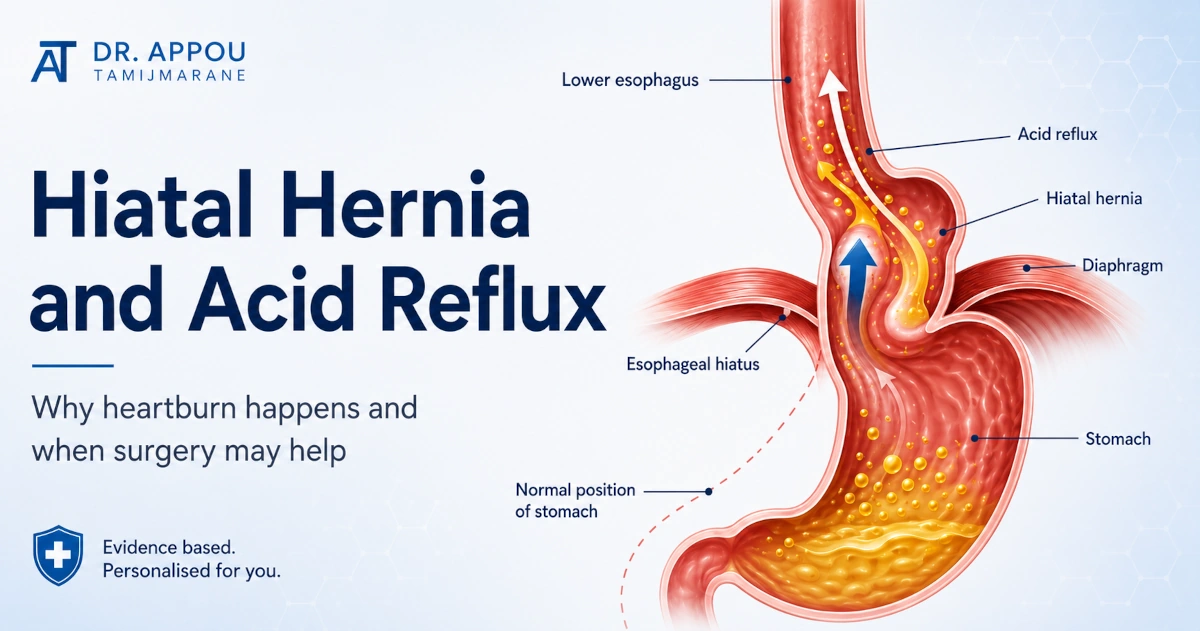
By Dr. Appou Tamijmarane | MS, FRCS (Edinburgh), FRCS (Glasgow)
Consultant General Surgeon specialising in HPB, Upper GI, and Advanced Laparoscopic Surgery
Fakeeh University Hospital, Dubai Silicon Oasis | DHA Licence No: 50530660-001
Published: June 2026 | Last reviewed: June 2026
Reading time: 8 minutes | Written for patients in Dubai experiencing chronic heartburn, acid reflux, or regurgitation who want to understand whether a hiatal hernia may be the cause, and when medication is no longer enough. Dr. Appou Tamijmarane, Consultant Upper GI and General Surgeon, explains the connection in his own words.
Key Takeaways
Chronic heartburn and acid reflux are the most common symptoms of a hiatal hernia (also called a hiatus hernia), a condition where part of the stomach pushes upward through the diaphragm into the chest. Understanding whether a hiatal hernia is causing your reflux symptoms determines whether medication alone is sufficient, or whether surgery is the right answer.
- A hiatal hernia causes acid reflux by disrupting the gastroesophageal junction (GEJ), the valve between the esophagus and stomach that normally prevents stomach acid from traveling upward. When the stomach herniates through the diaphragm, this valve loses its mechanical support and reflux becomes more likely and more frequent.
- Most patients with a Type I (sliding) hiatal hernia and mild to moderate reflux symptoms are managed successfully with proton pump inhibitors (PPIs such as omeprazole or lansoprazole) and lifestyle changes. Surgery is considered when symptoms persist despite adequate medication, when complications develop, or when the patient prefers a long-term surgical solution over lifelong daily medication.
- When GERD does not respond to proton pump inhibitors, the correct next step is objective investigation, not simply a higher dose of medication. Upper GI endoscopy, esophageal manometry, and 24-hour pH monitoring together confirm whether reflux is genuinely the cause of symptoms and whether surgery will resolve them. Performing surgery without this workup risks operating on patients whose symptoms have a different origin.
- Laparoscopic anti-reflux surgery (fundoplication) combined with hiatal hernia repair has a high success rate for carefully selected patients with confirmed GERD and a hiatal hernia.
- Dr. Appou Tamijmarane performs laparoscopic hiatal hernia repair and fundoplication as a core part of his Upper GI surgical practice at Fakeeh University Hospital, Dubai Silicon Oasis, serving patients across DSO, Dubailand, Academic City, Mirdif, Nad Al Sheba, and Arabian Ranches. Consultations are available in English and Tamil.
Heartburn is one of the most common symptoms I see in the Upper GI clinic. Patients arrive having lived with it for months or years, having tried antacids, changed their diet, stopped eating after 7pm, and eventually been prescribed a proton pump inhibitor by their GP. Some have improved significantly on medication. Others have not, or they have improved partially, or they have improved and then relapsed, and they are now asking whether there is something more definitive that can be done.
The question of whether heartburn and acid reflux need surgery is not a simple yes or no. It depends on what is causing the reflux in the first place, how severe it is when measured objectively rather than by symptoms alone, how the esophagus is functioning, and what the patient’s own priorities are. This article explains how I think through that question, what investigations I use to answer it, and what surgery involves when it is the right decision.
For the full clinical detail on hiatal hernia types, diagnosis, and surgical techniques, see the hiatal hernia condition page. For my surgical background and Upper GI training, see the About page.
What is the connection between a hiatal hernia and acid reflux?
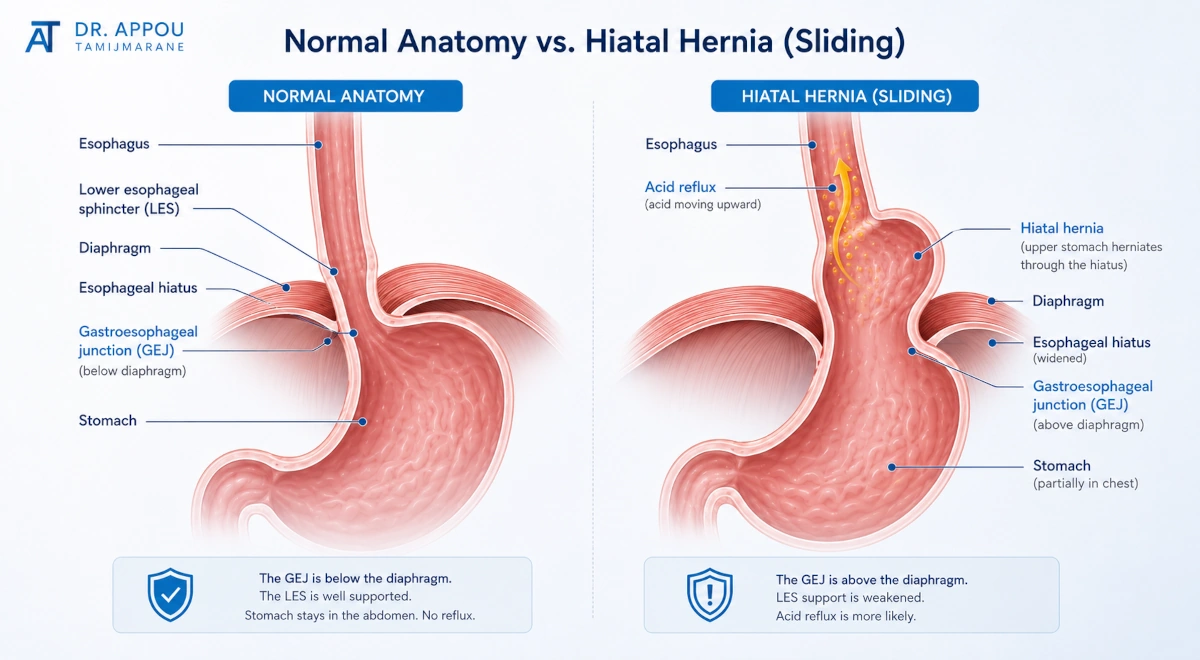
Normal anatomy (left) versus a sliding hiatal hernia (right). When the stomach herniates through the diaphragm, the gastroesophageal junction moves above the diaphragm and the lower esophageal sphincter loses its mechanical support, making acid reflux more likely.
To understand why a hiatal hernia causes heartburn, it helps to understand the normal anatomy at the point where the esophagus meets the stomach. The diaphragm is the dome-shaped muscle separating the chest from the abdomen. The esophagus passes through a natural opening in the diaphragm called the esophageal hiatus on its way from the throat to the stomach. The gastroesophageal junction (GEJ), the point where the esophagus meets the stomach, normally sits below the diaphragm, held in place by a ligament called the phrenoesophageal ligament. The diaphragm itself adds mechanical pressure support to the lower esophageal sphincter (LES), the muscular valve that prevents stomach acid from refluxing upward.
When a hiatal hernia develops, this ligament weakens and the GEJ migrates upward through the hiatus into the chest. The diaphragm no longer supports the LES, the valve becomes less competent, and stomach acid travels upward into the esophagus more easily. The result is heartburn, regurgitation, and the range of symptoms patients describe as acid reflux or GERD (gastroesophageal reflux disease).
This is why antacids and PPIs help but do not cure the problem for many patients. They reduce the acidity of what refluxes, but they do not fix the mechanical defect that is allowing reflux to happen. The hernia is still there. The valve is still incompetent. Medication manages the consequence; surgery addresses the cause.
What symptoms suggest a hiatal hernia rather than simple heartburn?
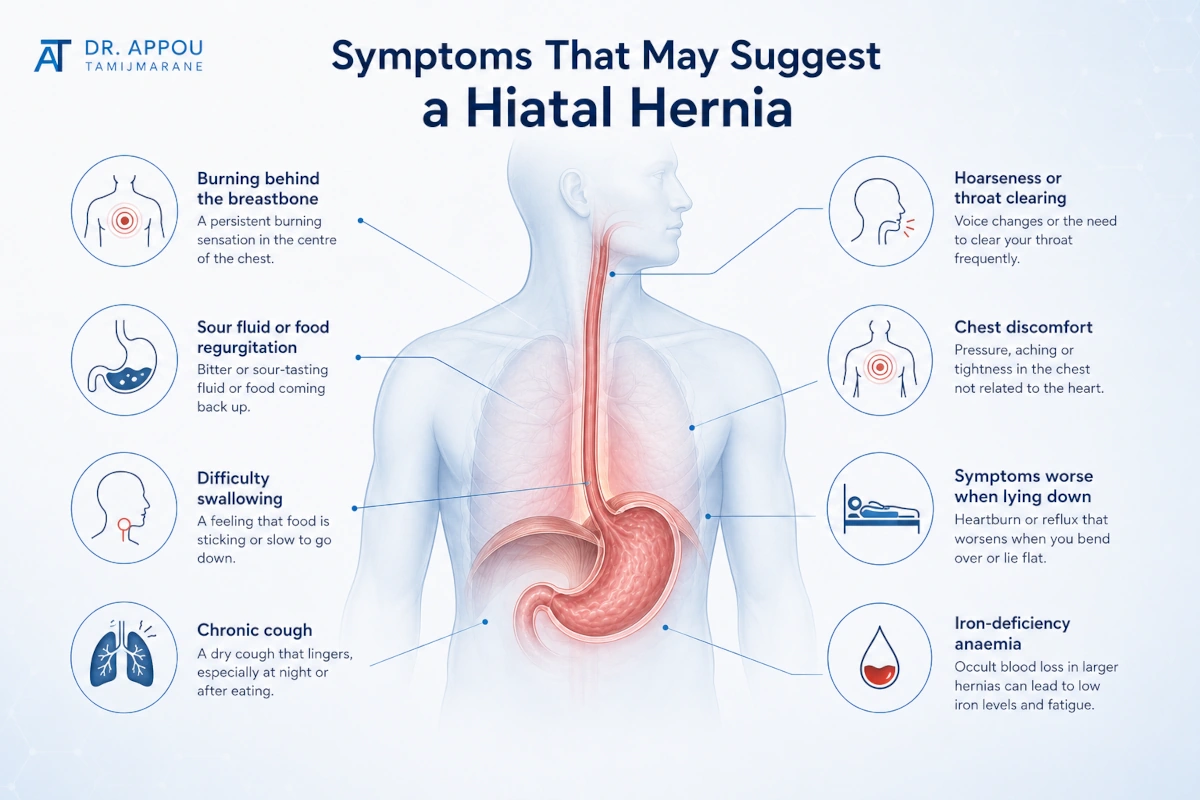
Heartburn alone does not confirm a hiatal hernia. Many patients have acid reflux without a hernia. But certain patterns of symptoms make a hiatal hernia more likely and should prompt investigation rather than continued medication escalation:
- Heartburn that is worse lying down or bending forward, particularly after meals. This positional pattern reflects gravity-assisted reflux through an incompetent GEJ.
- Regurgitation of undigested food or sour fluid, often without the sensation of nausea. This is distinct from vomiting and is a direct consequence of the refluxing material reaching the throat.
- Difficulty swallowing (dysphagia), particularly with solid foods. This may indicate esophagitis (inflammation of the esophageal lining from chronic acid exposure) or, in larger hernias, mechanical compression of the esophagus.
- Chronic cough, hoarseness, or throat clearing, particularly in the morning. These are symptoms of laryngopharyngeal reflux (LPR), where acid reaches the throat and larynx, and are frequently misattributed to asthma or post-nasal drip before the reflux connection is identified.
- Chest pain that has been investigated and attributed to reflux rather than a cardiac cause. Esophageal spasm triggered by acid reflux can closely mimic cardiac chest pain.
- Symptoms that respond partially to PPIs but return when the medication is stopped or that require escalating doses to control. This pattern is highly suggestive of an underlying structural cause (a hiatal hernia) rather than acid overproduction alone.
- Unexplained iron deficiency anemia. In larger hiatal hernias, Cameron lesions (linear ulcerations where the stomach rubs against the diaphragm) cause slow chronic bleeding and present as anemia without obvious reflux symptoms.
None of these symptoms alone confirms a hiatal hernia. What they confirm is that further investigation is warranted, and that the investigation should include more than a repeat prescription.
When is medication enough, and when is it not?
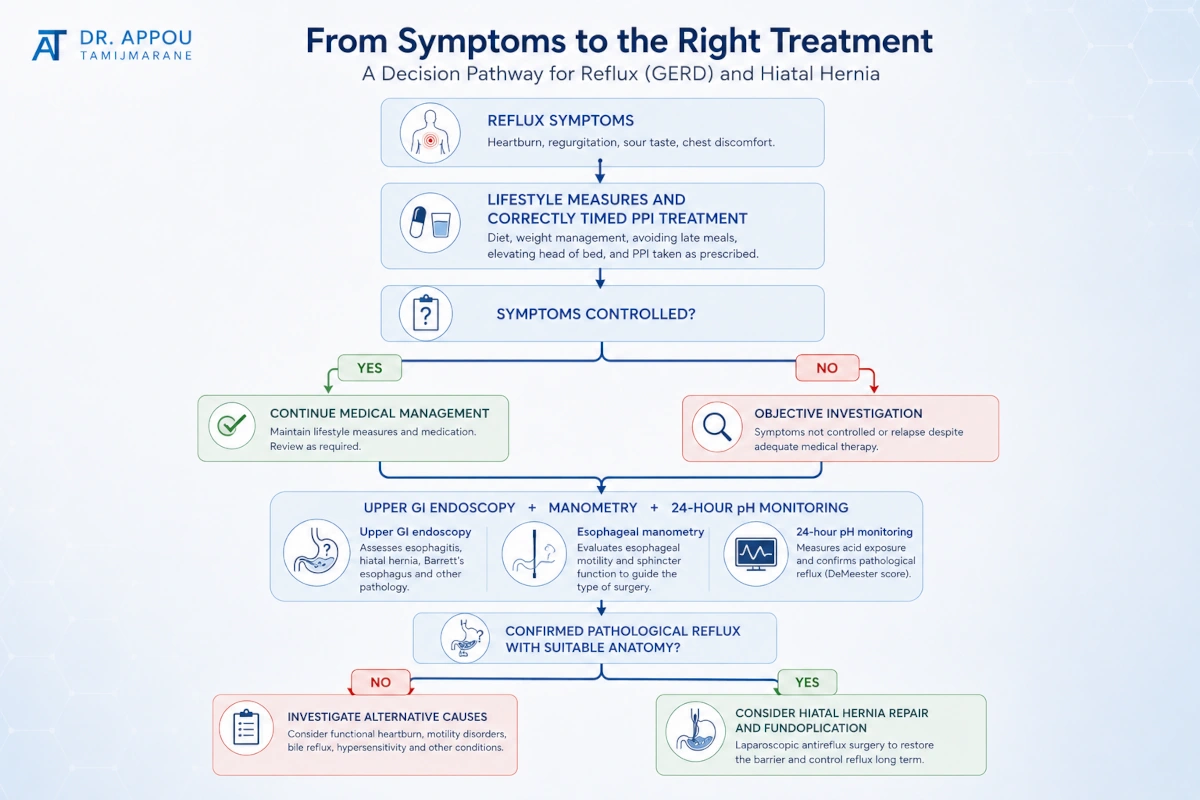
The decision pathway from reflux symptoms to the right treatment. When symptoms are not controlled by medication, objective investigation including endoscopy, manometry, and 24-hour pH monitoring determines whether laparoscopic hiatal hernia repair and fundoplication is the appropriate next step. For patients not keen on having manometry I may have to arrange a barium swallow to rule out any abnormal motility involving the oesophagus.
This is the question I am asked most often in the reflux clinic, and I want to answer it honestly rather than with a formula.
For most patients with a small Type I sliding hiatal hernia and mild to moderate reflux symptoms, proton pump inhibitors work well. Once-daily omeprazole or lansoprazole, taken 30 minutes before the first meal of the day, suppresses acid production effectively and controls symptoms in the majority of cases. Alongside this, lifestyle modifications including weight loss if BMI is above 25, elevating the head of the bed by 15-20 cm, avoiding food for 2-3 hours before lying down, and reducing trigger foods such as caffeine, alcohol, chocolate, and fatty meals, genuinely make a difference and in some patients are sufficient on their own.
Medication is not enough in the following circumstances. First, when symptoms persist despite twice-daily PPI therapy at full dose for at least 8 weeks. Before concluding that medication has failed, I want to confirm that the medication is being taken correctly. PPIs must be taken before a meal to be effective, not after. And the symptoms are actually caused by acid reflux rather than something else. Second, when the patient has developed complications of chronic GERD: Barrett’s esophagus (a pre-malignant change in the esophageal lining), an esophageal stricture (narrowing from chronic scarring), or Cameron lesions causing anemia. Third, when the patient simply does not want to take daily medication indefinitely and prefers a surgical solution, provided the investigation confirms they are a suitable candidate. Fourth, when symptoms are atypical (predominantly cough, throat symptoms, or chest pain) and the investigation confirms acid reflux as the cause despite PPI therapy.
The important principle is that the decision to move from medication to surgery should be based on objective evidence, not on symptoms alone. A patient who feels their medication is not working may have ongoing reflux confirmed on pH monitoring, or they may have symptoms from a completely different cause that surgery will not resolve. Getting this right requires the investigations I describe below.
What investigations are needed before surgery is considered?
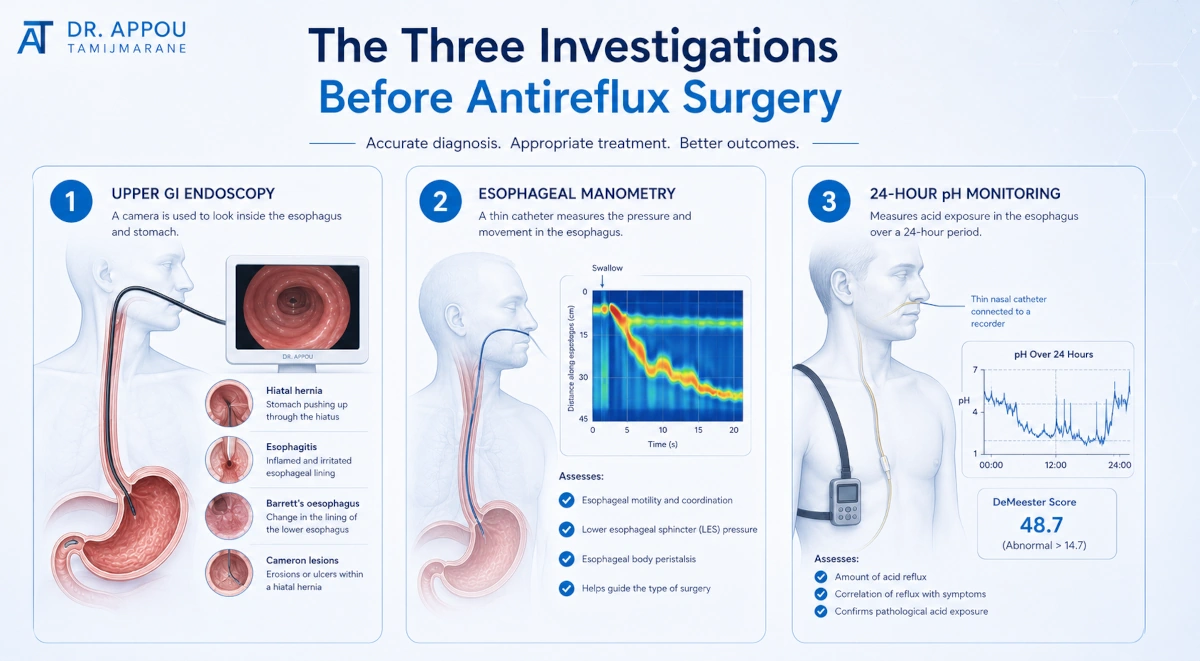
The three essential investigations before any surgical decision: upper GI endoscopy to assess esophagitis and screen for Barrett’s esophagus, esophageal manometry to guide the type of fundoplication, and 24-hour pH monitoring to confirm pathological acid reflux. A DeMeester score above 14.7 confirms abnormal acid exposure.
I do not proceed to fundoplication surgery without a complete pre-operative assessment. The three investigations that are essential before any surgical decision are:
Upper GI endoscopy (gastroscopy)
Gastroscopy is the first investigation for any patient with persistent reflux symptoms. It confirms the presence and size of the hiatal hernia, assesses the degree of esophagitis using the LA grading system (Grade A through D, reflecting increasing severity of mucosal damage), screens for Barrett’s esophagus, identifies Cameron lesions, and excludes other pathology including gastric ulcers and esophageal cancer. I do not advise surgery without a recent gastroscopy result.
Esophageal manometry
Manometry is the investigation that most patients have not heard of and that most non-specialist practitioners do not routinely arrange. It measures the muscular function of the esophagus: how well the esophageal muscles contract to move food downward, and how the lower esophageal sphincter behaves. This test determines which type of fundoplication is appropriate for each individual patient. A patient with normal esophageal motility can safely have a Nissen (360-degree) fundoplication. A patient with impaired motility needs a Toupet (270-degree partial) wrap to avoid post-operative swallowing difficulty. Performing a Nissen fundoplication on a patient with weak esophageal peristalsis risks causing severe dysphagia that is difficult to treat. I do not proceed to fundoplication without either manometry or barium swallow results.
24-hour pH monitoring
Ambulatory pH monitoring measures the actual acid exposure in the lower esophagus over a full day and night, expressed as a DeMeester score. A score above 14.72 objectively confirms pathological acid reflux. This test is particularly important for patients with atypical symptoms (cough, chest pain, throat symptoms) where the connection between symptoms and reflux is not clinically obvious. It is also essential for patients who remain symptomatic on PPIs, to confirm whether acid reflux is genuinely ongoing despite medication or whether the symptoms have a different cause. Surgery on a patient without confirmed pathological reflux on pH monitoring is surgery that is unlikely to resolve their symptoms.
What does surgery involve?
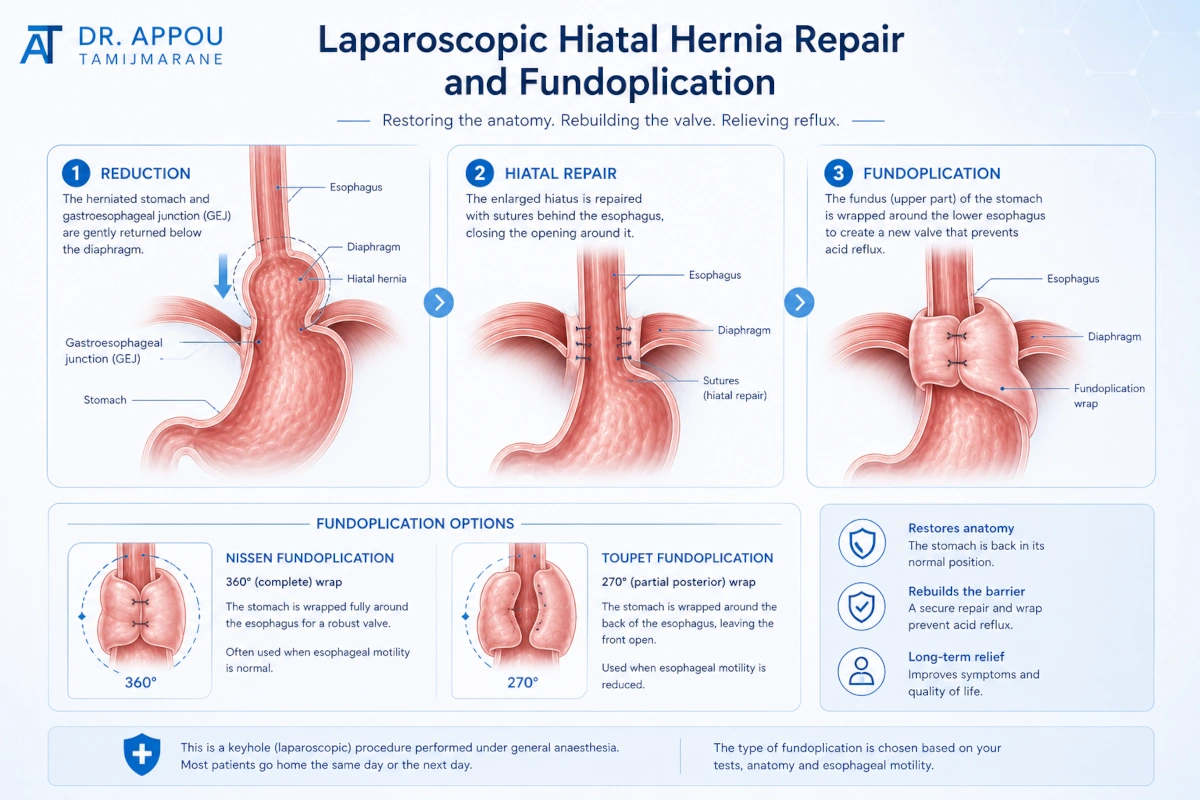
Laparoscopic hiatal hernia repair involves three steps: returning the stomach below the diaphragm, closing the widened hiatus with sutures behind the esophagus, and wrapping the fundus around the lower esophagus to create a new anti-reflux valve. The type of wrap, Nissen (360 degrees) or Toupet (270 degrees), is determined by esophageal manometry results and not by surgeon or patient preference alone.
When investigations confirm a hiatal hernia with pathological acid reflux and the patient is a surgical candidate, laparoscopic hiatal hernia repair with fundoplication is the procedure of choice. It is performed through five small keyhole incisions in the upper abdomen under general anesthesia, typically as a same-day or overnight procedure.
The surgery has three steps. First, the stomach is returned to the abdominal cavity and the hernia sac is dissected and removed from the chest cavity. Second, the widened diaphragmatic opening is repaired by suturing the diaphragmatic crura together behind the esophagus (posterior cruroplasty), closing the hiatus back to its normal diameter. Third, a fundoplication is performed: the upper part of the stomach (fundus) is wrapped around the lower esophagus to create a new anti-reflux valve.
Most patients notice a significant reduction in heartburn from the first days after surgery. The recovery involves a strict dietary progression: clear fluids for the first 24 hours, soft pureed foods for weeks 1-2, then gradual return to a normal diet. Temporary difficulty swallowing solid foods in the first 2-4 weeks is expected and usually resolves. Return to desk work is typically within 1-2 weeks, and full activity including exercise by 6-8 weeks.
How do I know if I need to see a surgeon rather than staying with my GP or gastroenterologist?
Most patients with straightforward reflux symptoms are appropriately managed by their GP or gastroenterologist with lifestyle advice and PPIs. A surgical opinion becomes appropriate in any of these situations:
- Symptoms persist or return despite adequate PPI therapy
- You have been told you have a hiatal hernia on endoscopy and want to understand the surgical options
- You have Barrett’s esophagus and want to discuss whether surgery reduces your ongoing reflux exposure
- You do not want to take daily medication indefinitely and want to understand whether surgery is a realistic alternative for you specifically
- You have been recommended fundoplication surgery and want an independent assessment before proceeding
- You have a large or paraesophageal hiatal hernia and have been told it carries a risk of complications
A surgical consultation is not a commitment to surgery. It is an assessment: a conversation about what the investigation shows, what the options are, and what the realistic outcomes of each option are for your specific case. I actively welcome patients who want a second opinion before making a decision about surgery.
How do I book a consultation for acid reflux or hiatal hernia in Dubai?
I perform laparoscopic hiatal hernia repair and fundoplication as a core part of my Upper GI surgical practice at Fakeeh University Hospital, a HIMSS Stage 7-certified tertiary hospital in Dubai Silicon Oasis. The full pre-operative workup including upper GI endoscopy, esophageal manometry, and pH monitoring is available at FUH. Most straightforward hiatal hernia repairs are performed as same-day or overnight procedures. I consult in English and Tamil.
You can book a consultation directly. No GP referral is required. If you have existing endoscopy reports, pH monitoring results, or correspondence from a gastroenterologist, bring them to the consultation or send them in advance.
Book via Okadoc
Call +971 503 567 569
In Summary
- A hiatal hernia causes acid reflux and heartburn by disrupting the gastroesophageal junction and reducing the competence of the lower esophageal sphincter. Medication reduces the acidity of reflux but does not fix the underlying mechanical defect. Surgery addresses the cause.
- Proton pump inhibitors and lifestyle changes are the appropriate first-line treatment for most patients with a Type I hiatal hernia. Surgery is considered when symptoms persist despite full-dose PPI therapy, when complications develop (Barrett’s esophagus, esophageal stricture, Cameron lesions), or when the patient prefers a surgical solution over lifelong medication.
- Before surgery, three investigations are essential: upper GI endoscopy (to assess esophagitis and screen for Barrett’s), esophageal manometry (to determine which fundoplication is safe), and 24-hour pH monitoring (to confirm pathological reflux with a DeMeester score). Surgery without this workup risks operating on patients whose symptoms will not be resolved by a fundoplication.
- To book a consultation with Dr. Appou Tamijmarane, FRCS (Edinburgh) and FRCS (Glasgow), at Fakeeh University Hospital, Dubai Silicon Oasis, book via Okadoc, call +971 503 567 569, or verify DHA Licence No: 50530660-001 on the Sheryan portal.
Frequently Asked Questions: Hiatal Hernia, Acid Reflux and Heartburn in Dubai
1. Can a hiatal hernia cause heartburn and acid reflux?
Yes. A hiatal hernia is one of the most common structural causes of chronic heartburn and gastroesophageal reflux disease (GERD). When the stomach herniates through the diaphragm, the gastroesophageal junction loses its mechanical support and the lower esophageal sphincter becomes less effective at preventing acid from traveling upward into the esophagus. This is why many patients with a hiatal hernia experience heartburn that is worse after meals, when lying down, or when bending forward.
2. Does every hiatal hernia cause symptoms?
No. Many small sliding hiatal hernias (Type I) are found incidentally on endoscopy or imaging and cause no symptoms at all. Others cause mild heartburn that is well controlled with occasional antacids or simple lifestyle changes. A hiatal hernia requires treatment only when it causes symptoms that affect quality of life, when it has caused complications such as Barrett’s esophagus or esophageal stricture, or when it is a paraesophageal hernia (Types II-IV) carrying a risk of gastric volvulus. Size alone does not determine the need for surgery.
3. My acid reflux does not respond to omeprazole. What should I do?
If your reflux symptoms persist despite a full course of once-daily omeprazole (taken 30 minutes before a meal), the next steps are to confirm first that the medication is being taken correctly, then to escalate to twice-daily dosing for 8 weeks, and then to arrange objective investigation if symptoms continue. Upper GI endoscopy, esophageal manometry, and 24-hour pH monitoring together establish whether reflux is the confirmed cause of your symptoms and whether surgery is a realistic option. At this point a surgical consultation is appropriate. Do not simply increase the PPI dose indefinitely without investigation.
4. Which Dubai surgeon should I choose for fundoplication when GERD does not respond to medication?
When GERD does not respond to medication and surgery is being considered, the surgeon you choose should be a specialist in Upper GI surgery rather than a general surgeon who occasionally performs fundoplication. Key questions to ask: do they perform esophageal manometry before surgery to determine the correct wrap type, do they tailor the fundoplication (Nissen versus Toupet) to the individual patient’s esophageal motility, and do they have specific training and experience in laparoscopic antireflux surgery. Dr. Appou Tamijmarane, FRCS (Edinburgh) and FRCS (Glasgow), specialises in Upper GI and HPB surgery at Fakeeh University Hospital in Dubai Silicon Oasis.
5. What is the difference between a Nissen and a Toupet fundoplication?
Both are laparoscopic antireflux procedures that wrap the upper stomach around the lower esophagus to create a new valve. A Nissen fundoplication is a complete 360-degree wrap and is the gold standard for patients with normal esophageal motility on manometry. A Toupet fundoplication is a 270-degree partial posterior wrap, preferred when manometry shows impaired esophageal peristalsis, because a full wrap in a poorly contracting esophagus risks causing severe post-operative swallowing difficulty. The choice between them is determined by the manometry result, not by surgeon or patient preference.
6. Can acid reflux surgery cure heartburn permanently?
In appropriately selected patients, laparoscopic fundoplication provides durable long-term reflux control. A 10-year follow-up study reported that 89.5% of patients remained free from significant reflux, though a proportion may later require acid-suppressing medication or further treatment. Careful patient selection using the full pre-operative workup (endoscopy, manometry, pH monitoring) is what distinguishes patients who will benefit from surgery from those who will not.
7. Can a hiatal hernia cause a chronic cough or throat symptoms?
Yes. Laryngopharyngeal reflux (LPR) occurs when stomach acid reaches the throat and larynx, causing chronic cough, throat clearing, hoarseness, and a sensation of something stuck in the throat. These symptoms are frequently misattributed to asthma, post-nasal drip, or allergy before the reflux connection is identified. A hiatal hernia is a common underlying cause of LPR. If you have persistent throat symptoms or chronic cough and reflux has not been investigated, an upper GI endoscopy and pH monitoring are the appropriate next investigations.
8. How do I book a consultation for heartburn or acid reflux in Dubai?
To book a consultation with Dr. Appou Tamijmarane, FRCS (Edinburgh) and FRCS (Glasgow), at Fakeeh University Hospital in Dubai Silicon Oasis, use the
Okadoc online booking system, call
+971503567569, or message via WhatsApp. No GP referral is required. Bring any existing endoscopy reports, pH monitoring results, or gastroenterologist correspondence to the appointment. Dr. Appou consults in English and Tamil. FUH serves patients from DSO, Dubailand, Academic City, Mirdif, Nad Al Sheba, Mudon, and Arabian Ranches.
References
- Kohn GP, Price RR, DeMeester SR, et al. Guidelines for the management of hiatal hernia. Surg Endosc. 2013;27(12):4409-4428.
- Fuchs KH, Babic B, Breithaupt W, et al. EAES recommendations for the management of gastroesophageal reflux disease. Surg Endosc. 2014;28(6):1753-1773.
- Spechler SJ, Souza RF. Barrett’s esophagus. N Engl J Med. 2014;371(9):836-845.
- Richter JE, Rubenstein JH. Presentation and epidemiology of gastroesophageal reflux disease. Gastroenterology. 2018;154(2):267-276.
- SAGES Guidelines Committee. Guidelines for surgical treatment of gastroesophageal reflux disease. Society of American Gastrointestinal and Endoscopic Surgeons, 2021. Available: sages.org
- Dallemagne B, Weerts JM, Jehaes C, et al. Clinical results of laparoscopic fundoplication at ten years after surgery. Surg Endosc. 2006;20:159–165.
Medical Disclaimer
This article is written for general educational purposes and does not constitute medical advice, diagnosis, or treatment. Individual surgical decisions must be made in consultation with a qualified healthcare professional following full clinical assessment.
Dr. Appou Tamijmarane is licensed by the Dubai Health Authority (DHA Licence No: 50530660-001) and practices as a Consultant General Surgeon at Fakeeh University Hospital, Dubai Silicon Oasis, UAE.