22 October 2025

Hernia Surgery in Dubai: What to Ask, What to Expect, and How to Choose Your Surgeon


By Dr. Appou Tamijmarane | MS, FRCS (Edinburgh), FRCS (Glasgow)
Consultant General Surgeon specializing in HPB, Upper GI, and Advanced Laparoscopic Surgery
Fakeeh University Hospital, Dubai Silicon Oasis | DHA License No: 50530660-001
Published: 22 Oct 2025 | Last reviewed: 20 May 2026

Reading time: 15 minutes | Written for patients in Dubai considering or recovering from hernia surgery.
Dr. Appou Tamijmarane, Consultant General Surgeon, explains the key decisions in his own words

Hernia is one of the most common surgical conditions I treat. Over more than 35 years of surgical practice, 18 of them as an NHS Consultant at Raigmore Hospital in Scotland, I have performed hundreds of hernia repairs, from straightforward first-time inguinal hernias to complex recurrent cases where a previous repair has failed. In my current practice at Fakeeh University Hospital in Dubai Silicon Oasis, hernias remain a significant part of what I do every week.

Despite how common hernias are, I find that patients arrive in my clinic with a great deal of confusion and sometimes anxiety about whether they need surgery at all, about which technique is appropriate, and about what determines whether the repair will last. In this article, I want to answer those questions honestly, based on my own clinical experience and the specific technical choices I make in practice.

If you would like broader guidance on choosing a general surgeon in Dubai, I have written a separate guide covering credentials, DHA licensing, and what to expect at a first consultation: How to Choose a General Surgeon in Dubai.

What is a hernia, and when does it need surgery?

A hernia occurs when an organ or a section of fatty tissue pushes through a weak point or gap in the surrounding muscle or connective tissue. In the abdomen and groin, the most common types are:

  • Inguinal hernia:in the groin, the most frequent type in men
  • Femoral hernia: at the top of the inner thigh, more common in women, and more prone to complications
  • Umbilical hernia: at or near the navel
  • Incisional hernia: through a previous surgical scar
  • Ventral or epigastric hernia: in the upper or midline abdomen
The question I am asked most often is: does every hernia need surgery? The honest answer is probably not, at least, not immediately. If a hernia is very small and causing minimal symptoms, it is reasonable to keep a close eye on things and make some lifestyle adjustments. Reducing body weight reduces the intra-abdominal pressure on the inguinal openings, and improving core muscular strength can help support the abdominal wall. For older patients with small asymptomatic hernias who are not fit for surgery, a hernia truss or belt can hold the hernia in place and allow comfortable daily life.

However, a watchful waiting approach is only appropriate when the hernia is genuinely asymptomatic and reducible, meaning it can be pushed back in. There is a risk that any hernia will gradually increase in size and, as it does, it becomes more symptomatic and more complex to repair. My clinical advice is that when a hernia becomes symptomatic, it should be repaired as early as practicable.

Warning signs that require urgent attention

There are specific circumstances where a hernia stops being a condition to watch and becomes a surgical emergency. If you or a family member develop any of the following, go to the emergency department without delay, do not wait for a routine appointment:

  • A lump at the hernia site that cannot be pushed back in (irreducible hernia)
  • Pain at the hernia site that is new, worsening, or severe
  • Nausea or vomiting associated with the hernia
  • Redness, heat, or discoloration of the skin over the hernia
These signs may indicate an obstructed or strangulated hernia, a condition where bowel becomes trapped in the hernia sac and its blood supply is compromised. The longer this is left, the higher the risk of bowel necrosis, meaning the trapped section of bowel loses its blood supply entirely and must be removed. Emergency hernia surgery carries significantly higher risk than planned elective repair. Increased chances of infection, bleeding, the need for open surgery, and, in the most serious cases, bowel resection and reconnection. The message is simple: if in doubt, seek urgent surgical advice.

Understanding your surgical options: open, laparoscopic TAPP, and TEP

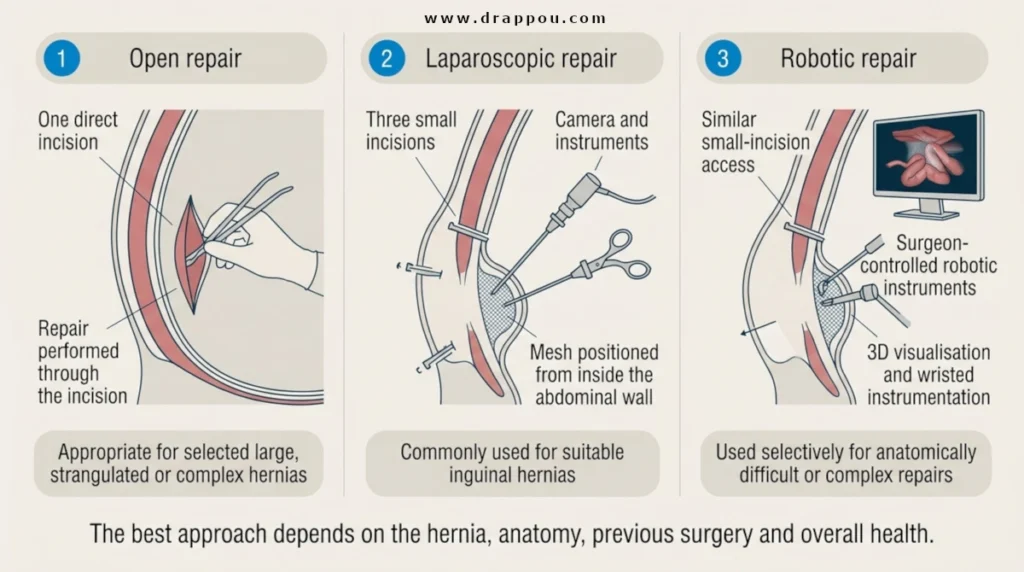
When a hernia does require repair, there is not a single correct technique that applies to every patient. The right approach depends on the type of hernia, the patient’s anatomy, their previous surgical history, their overall health, and in some cases, their own informed preference. Let me explain the main options and the clinical reasoning behind how I choose between them.

Open hernia repair

Open repair involves a direct incision over the hernia site. A mesh is placed to reinforce the abdominal wall, this is the gold standard approach known as a tension-free mesh repair, and it has largely replaced older suture-only techniques. Open repair remains the right choice in a number of specific situations: for patients who have had previous laparoscopic repairs that have recurred, for cases where access to the groin via a keyhole approach is difficult due to prior surgery, and occasionally for patients whose general health makes a longer anesthetic inadvisable.

Laparoscopic TAPP (Transabdominal Preperitoneal) repair

TAPP is my preferred laparoscopic approach for inguinal hernia repair. A camera is passed inside the abdomen, the peritoneal lining is lifted away from the hernia site, a mesh is positioned behind the abdominal wall to cover the defect, and the peritoneum is then closed back over the mesh. The advantages are smaller incisions, less post-operative pain, faster return to normal activity, and a lower risk of wound infection compared to open surgery.

I favor TAPP over TEP for most cases because the view of the hernia anatomy is clearer and more consistent, particularly in larger or more complex defects. This gives me greater confidence in precise mesh positioning, which is directly related to recurrence rates.

Laparoscopic TEP (Totally Extraperitoneal) repair

TEP is also laparoscopic, but the camera is passed in the space between the abdominal muscles and the peritoneal lining, without entering the abdominal cavity itself. For straightforward hernias in experienced hands, TEP produces equivalent results to TAPP. However, in my own experience, I have encountered a slightly higher recurrence rate with the TEP approach in more difficult or larger hernias. The working space in TEP is more confined, and in complex cases, precise mesh positioning becomes technically harder. For this reason, TAPP is currently my preferred approach for most inguinal hernias.

What about suture-only repair – no mesh?

Some patients prefer not to have any synthetic material left in their body, and ask about suture-only repair. There are well-established techniques for this, Bassini’s repair being one of the most recognized. I respect this patient preference and will discuss it openly. However, it is important that patients understand the data: the recurrence rate after suture-only hernia repair is significantly higher, in the order of 10 to 20%, compared to mesh repair, where recurrence rates in experienced hands should be well under 5%. Mesh repair, whether open or laparoscopic, remains the evidence-based standard for the majority of patients. Any discussion about avoiding mesh should be an informed one.Robotic-assisted hernia repair

Robotic platforms add enhanced three-dimensional visualization and wristed instrument movement, which is particularly useful in complex cases such as large ventral hernias or recurrent repairs in scarred tissue. At Fakeeh University Hospital I have access to robotic surgical platforms, and I use this approach selectively where it offers a genuine advantage for the patient rather than as a default for all cases.

Recurrence: what drives it, and what my rate tells you

In my practice, my hernia recurrence rate is approximately 2%. I am transparent about this figure because I think patients have the right to ask their surgeon about their outcomes, and surgeons should be willing to answer.

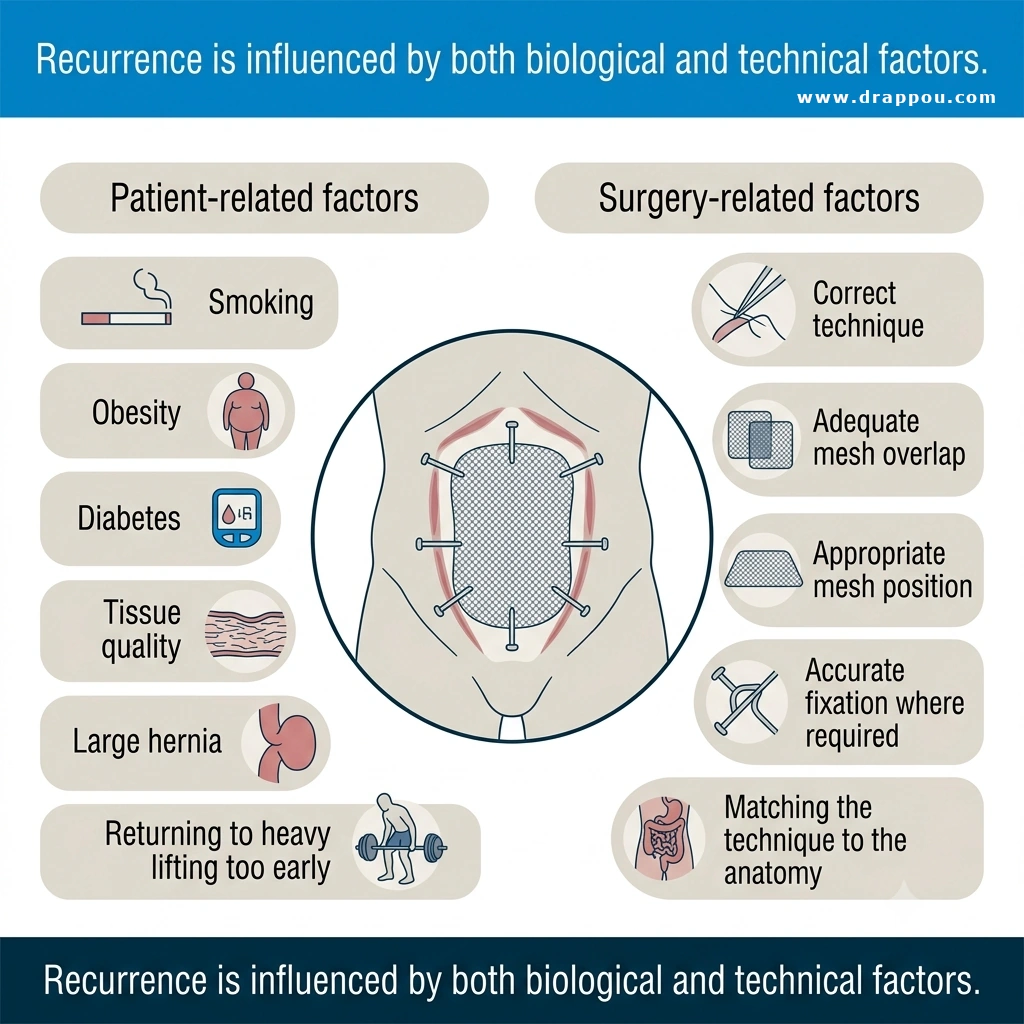
A 2% recurrence rate does not mean the surgery has failed in those cases. When you perform hundreds of hernia repairs, some will recur, and the reasons are not always within the surgeon’s control. Patient-related factors play a significant role: obesity, diabetes, weakened connective tissue, very large hernia defects, and smoking all increase the biological risk of recurrence regardless of surgical technique. These are factors I discuss with patients before surgery, and where possible, I encourage patients to optimize their health, particularly weight, before an elective repair.

On the technical side, recurrence is most commonly related to inadequate mesh coverage of the hernia defect, poor mesh fixation, or a mismatch between the technique chosen and the complexity of the anatomy. This is why technique selection matters, and why my preference for TAPP over TEP in complex cases is not arbitrary, it is based on what I have found gives me the most reliable view and the most consistent mesh placement.

Recurrent hernias and complex repairs: what patients need to know

When a patient comes to me after a hernia has recurred following a previous repair, they are often frustrated and worried. I want to be honest with them about what the corrective operation involves, because it is not the same as the first repair.

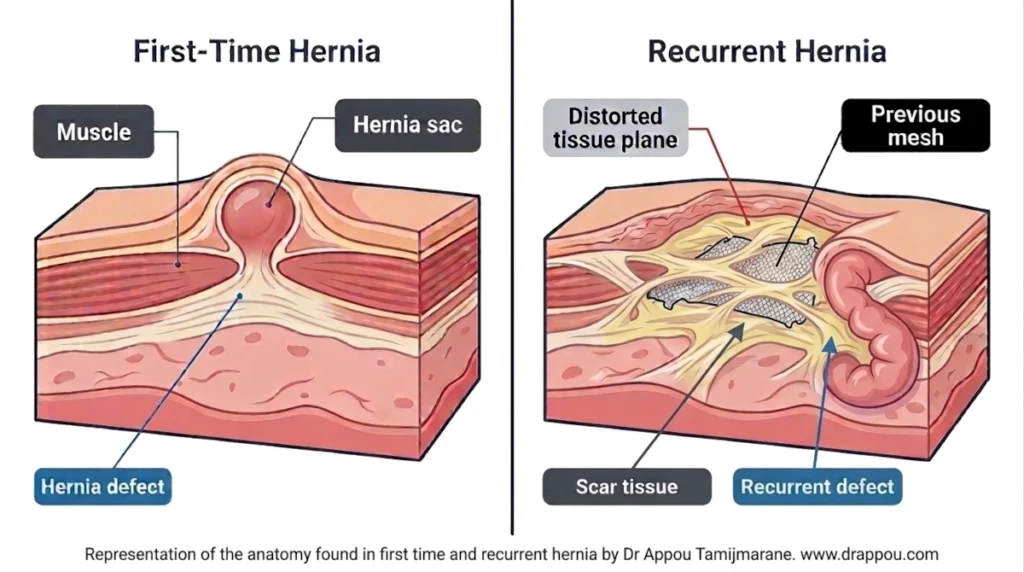
Operating through previously scarred tissue is technically more demanding. The anatomy is distorted, tissue planes that would normally be clear are adherent, and the original mesh from the prior repair cannot be removed, it has incorporated into the surrounding tissue and become part of the body. The presence of existing mesh actually makes the second operation considerably harder: we have to work around it, and the risk of inadvertently damaging nearby structures is higher.

For recurrent hernias following an open primary repair, a laparoscopic approach is often still possible and preferable, as it allows us to approach the hernia from a different angle to the original scar tissue. For recurrent hernias following a previous laparoscopic repair, I often prefer an open approach for the redo surgery, for exactly the same reason.

I always counsel patients facing a recurrent hernia repair about the increased risks compared to a primary repair: a higher likelihood of bleeding, a greater risk of infection, a higher chance of conversion to open surgery if the laparoscopic approach becomes unsafe, and a recurrence rate that remains higher than a first repair even with an experienced surgeon. Choosing a surgeon with substantial experience in complex and recurrent hernia cases is not simply a preference, it is genuinely relevant to the outcome.

Hernia repair at Fakeeh University Hospital, Dubai Silicon Oasis

I perform both elective and emergency hernia surgery at Fakeeh University Hospital, a HIMSS Stage 7-certified tertiary hospital in Dubai Silicon Oasis. FUH provides access to laparoscopic and robotic surgical platforms, advanced imaging including CT and ultrasound for pre-operative assessment, and dedicated surgical nursing teams.

For patients across south-east Dubai, including DSO, Dubailand, Academic City, Mirdif, Nad Al Sheba, Mudon, and Arabian Ranches, FUH is accessible within 20 mins drive and offers parking. I consult in both English and Tamil.

My surgical training in hernia surgery spans more than three decades: from laparoscopic TAPP and TEP courses at Edinburgh, Hexham, and NUGITS, to cadaveric abdominal wall reconstruction training in Bristol, to complex ventral hernia management at Raigmore Hospital managing the full surgical workload of a regional tertiary center. I have trained junior doctors and specialist registrars in hernia techniques throughout my NHS career.

How much does Hernia Surgery Cost in Dubai?

The cost of hernia surgery in Dubai varies depending on the technique used, whether mesh is required, and the complexity of the case. Hernia surgery at FUH is covered by most major insurance providers. For more information on FUH insurance coverage see the FUH booking form on Okadoc. Patients wishing to self-pay are welcome to request a cost estimate following the initial consultation, once the surgical approach has been confirmed.

Recovery from hernia surgery: realistic expectations

Patients often ask me when they can drive, return to work, or go back to the gym. The honest answer is that it depends on the type of repair and the complexity of the case, but here are the realistic general timeframes I discuss with patients:

After laparoscopic repair (TAPP or TEP)

  • Return to light activity and desk work: typically 5–10 days
  • Driving: when you can perform an emergency stop comfortably, usually 1–2 weeks
  • Manual work or heavy lifting: 4–6 weeks
  • Return to exercise: from 4 weeks, building gradually

After open repair

  • Return to desk work: 2–3 weeks
  • Manual work or heavy lifting: 6–8 weeks
  • Exercise: from 6 weeks, building gradually
These are general guides. Individual recovery depends significantly on age, fitness, the size of the hernia, and whether any complication arises. I see all my patients at a post-operative follow-up appointment to check healing and answer questions about returning to activity. If you have a physically demanding job or a specific event to prepare for, let me know at the consultation so we can plan appropriately.

Choosing a hernia surgeon in Dubai: the questions worth asking

In my guide to choosing a general surgeon in Dubai, I covered the core factors in detail, DHA licensing, postgraduate qualifications, surgical volume, and communication. For hernia surgery specifically, there are a few additional questions I would encourage any patient to ask:

  • What is your preferred technique for my type of hernia, and why?
  • What is your recurrence rate for this procedure?
  • Have you managed complex or recurrent hernias similar to mine?
  • What mesh will you use, and why?
  • Under what circumstances would you convert from laparoscopic to open surgery during the operation?
A surgeon who gives direct, considered answers to these questions is a surgeon who has the experience and confidence to back up their approach. Evasive or dismissive answers should prompt you to seek a second opinion, which I actively encourage for any patient facing a major operation.
You can verify my DHA license on the DHA Sheryan portal (License No: 50530660-001) and book an initial consultation via the Okadoc booking system or by calling +971 503 567 569.

Further reading

Frequently Asked Questions: Hernia Surgery in Dubai

 
1. Does every hernia need surgery?
Not necessarily. Small, asymptomatic hernias can be monitored with lifestyle adjustments. However, any hernia that is causing symptoms should be assessed by a surgeon, and any hernia that becomes irreducible or causes pain, nausea, or vomiting requires urgent surgical review.
2. What is the difference between TAPP and TEP laparoscopic hernia repair?
3. What is a recurrent hernia and is it harder to repair?
4. What is the typical recurrence rate after hernia repair?
5. When should I go to the emergency department for a hernia?
6. How long is recovery from hernia surgery?
7. What is the cost of hernia surgery in Dubai?
8. How do I book a hernia consultation with Dr Appou at Fakeeh University Hospital?

References

  • HerniaSurge Group. International guidelines for groin hernia management. Hernia. 2018;22(1):1–165.
  • Burcharth J, Pommergaard HC, Bisgaard T, Rosenberg J. Patient-related risk factors for recurrence after inguinal hernia repair: a systematic review and meta-analysis of observational studies. Surg Innov. 2015;22(3):303–317.
  • Köckerling F, Bittner R, Jacob DA, et al. TEP versus TAPP: comparison of the perioperative outcome in 17,587 patients with a primary unilateral inguinal hernia. Surg Endosc. 2015;29(12):3750–3760.
  • NICE. Inguinal hernia repair (IPG163). National Institute for Health and Care Excellence, 2004 (reviewed 2022). Available: www.nice.org.uk/guidance/ipg163
  • EU Hernia Trialists Collaboration. Repair of groin hernia with synthetic mesh: meta-analysis of randomized controlled trials. Ann Surg. 2002;235(3):322–332.

Medical Disclaimer

This article is written for general educational purposes and does not constitute medical advice, diagnosis, or treatment. Individual surgical decisions must be made in consultation with a qualified healthcare professional following full clinical assessment. If you are experiencing symptoms described in this article, including any signs of hernia obstruction or strangulation, please seek medical attention promptly. Dr. Appou Tamijmarane is licensed by the Dubai Health Authority (DHA License No: 50530660-001) and practices as a Consultant General Surgeon at Fakeeh University Hospital, Dubai Silicon Oasis, UAE. Patient testimonials referenced elsewhere on this website are published with consent in accordance with DHA advertising guidelines.

Chat with us