
22 October 2025
Choosing a hernia surgeon in Dubai should involve more than checking availability or location. Patients should ask about the surgeon’s experience with their specific hernia type, preferred repair technique, recurrence rate, mesh choice, approach to complex or recurrent cases, and whether a second opinion is appropriate.
Before choosing a hernia surgeon, patients should understand what questions to ask, why recurrence rates matter, and what makes complex hernia repair different from a straightforward first-time operation.
Hernia is one of the most common surgical conditions I treat. Over more than 35 years of surgical practice, including 18 years as an NHS Consultant at Raigmore Hospital in Scotland, I have performed hundreds of hernia repairs, from straightforward first-time inguinal hernias to complex recurrent cases where a previous repair has failed.
Many patients arrive at consultation unsure not only whether they need surgery, but how to choose the right surgeon for their hernia. This article focuses on that decision: what to ask, how to understand recurrence rates, when a second opinion is useful, and why experience with complex or recurrent hernias matters.
Patients often ask how to find the best hernia surgeon in Dubai. In my view, the better question is whether the surgeon can explain their recommended technique, recurrence rate, mesh choice, experience with complex cases, and approach to second opinions in a way that is clear and specific to you.
For a complete guide to hernia types, when surgery is needed, how open, laparoscopic and robotic repair compare, recovery timelines, cost, insurance and emergency warning signs, read my full guide to hernia surgery in Dubai.
In my guide to choosing a general surgeon in Dubai, I covered the core factors in detail: DHA licensing, postgraduate qualifications, surgical volume, and communication. For hernia surgery specifically, there are additional questions I would encourage any patient to ask:
A surgeon who gives direct, considered answers to these questions is one who has the experience and confidence to back up their approach. Evasive or dismissive answers should prompt you to seek a second opinion, which I actively encourage for any patient facing a major operation.
When choosing a hernia surgeon, convenience, cost, hospital reputation, and technology all matter, but none of them should be the only reason you choose where to have surgery. Hernia repair is a technical operation, and the right decision depends on the surgeon’s judgment, your hernia type, your anatomy, your medical fitness, and your individual risk of recurrence or complications.
The best decision is usually based on clear assessment, appropriate technique selection, surgeon experience, hospital support, transparent risk discussion, and confidence that your questions have been answered properly.
In my practice, my hernia recurrence rate is approximately 2%. I am transparent about this figure because I think patients have the right to ask their surgeon about their outcomes, and surgeons should be willing to answer. It is worth noting that individual outcomes vary depending on hernia type, patient health, and anatomy; your surgeon will discuss your personal risk profile at consultation.
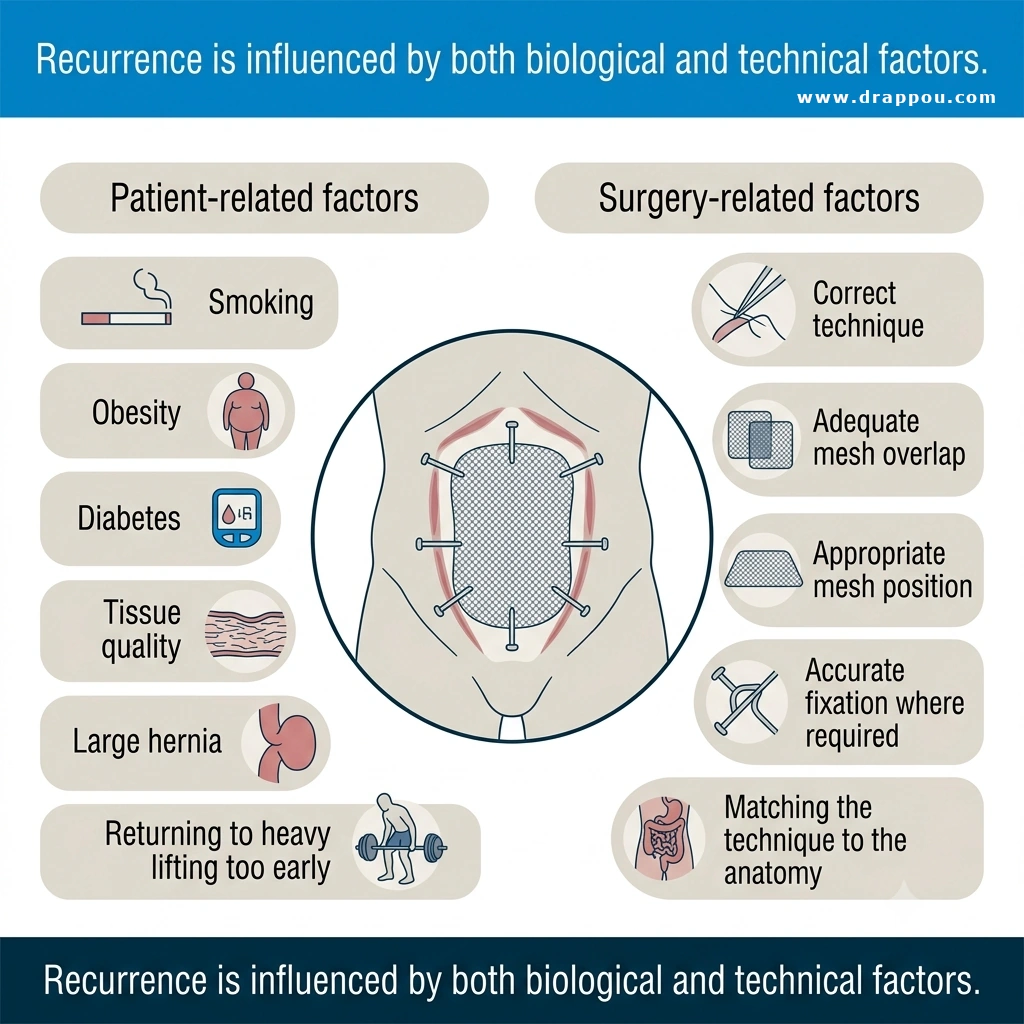
A recurrence rate is not a guarantee. When you perform hundreds of hernia repairs, some will recur, and the reasons are not always within the surgeon’s control. Patient-related factors play a significant role: obesity, diabetes, weakened connective tissue, very large hernia defects, and smoking all increase the biological risk of recurrence regardless of surgical technique. These are factors I discuss with patients before surgery, and where possible, I encourage patients to optimize their health, particularly weight, before an elective repair.
On the technical side, recurrence is most commonly related to inadequate mesh coverage, poor mesh fixation, or a mismatch between the technique chosen and the complexity of the anatomy. This is why technique selection matters, and why asking your surgeon why they recommend a particular approach for your hernia is more useful than simply asking which technique they use most often.
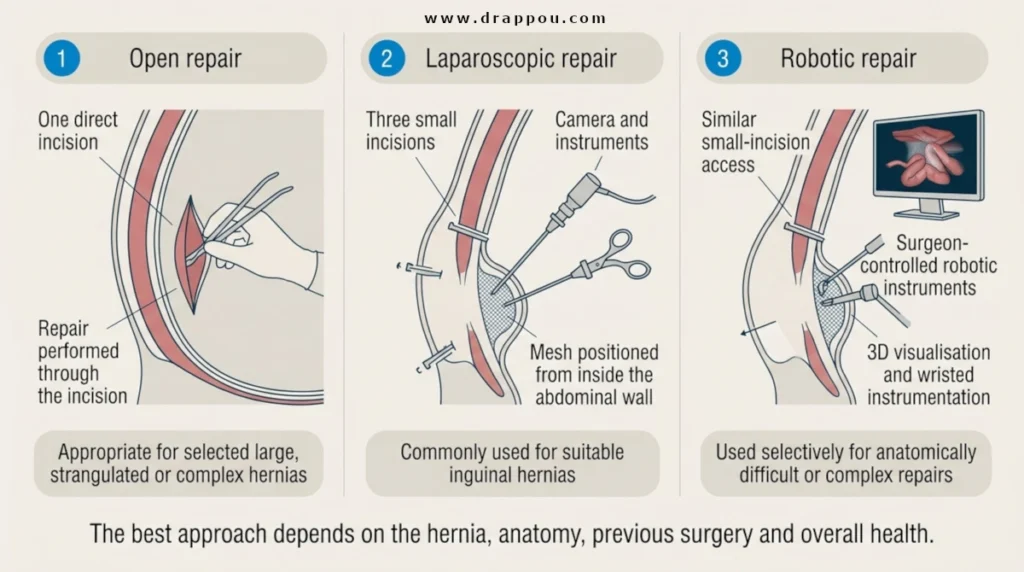
For a detailed comparison of open, laparoscopic TAPP, TEP, and robotic repair, including when each is most appropriate, see my hernia surgery guide.
When a patient comes to me after a hernia has recurred following a previous repair, they are often frustrated and worried. I want to be honest with them: a recurrent repair is not the same as a first operation. The surrounding tissue is scarred, the anatomy is distorted, and the original mesh has incorporated into the tissue. Operating through this demands specific experience.
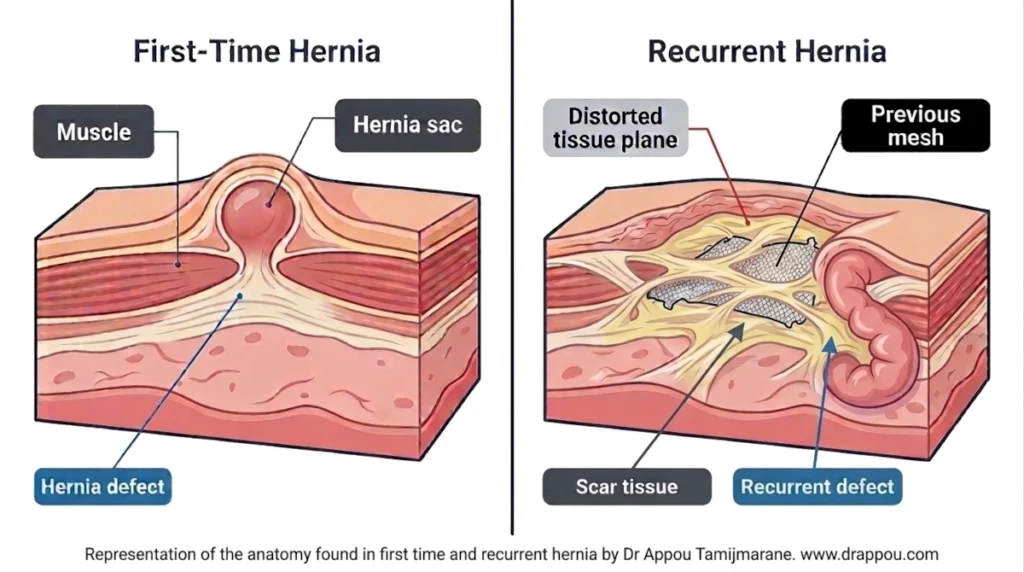
I always counsel patients facing a recurrent hernia repair about the increased risks compared to a primary repair: a higher likelihood of bleeding, a greater risk of infection, a higher chance of conversion to open surgery if the laparoscopic approach becomes unsafe, and a recurrence rate that remains higher than a first repair even with an experienced surgeon. Choosing a surgeon with substantial experience in complex and recurrent hernia cases is not simply a preference, it is genuinely relevant to the outcome.
For more detail on how recurrent hernias are assessed and repaired, read the recurrent hernia section of my hernia surgery guide.
I actively encourage second opinions. If a patient is unsure whether surgery is the right step, or if they have been told they need an operation but want another perspective, that is a completely reasonable position. A confident, experienced surgeon will welcome this rather than feel threatened by it.
A second opinion is particularly valuable when:
You can verify any DHA-licensed surgeon’s registration on the DHA Sheryan portal before booking a consultation.
For patients in Dubai, the hospital setup also matters. Hernia surgery may require ultrasound or CT imaging, anesthesia assessment, insurance pre-authorization, robotic or laparoscopic operating facilities, and follow-up after surgery. At Fakeeh University Hospital in Dubai Silicon Oasis, these services are available within the same care pathway, which can make planning and recovery more straightforward for patients.
You can book a consultation with Dr. Appou Tamijmarane at Fakeeh University Hospital, Dubai Silicon Oasis via the Okadoc booking system or messaging via WhatsApp. You can verify Dr. Appou’s DHA license (No: 50530660-001) on the DHA Sheryan portal before booking.
This article is written for general educational purposes and does not constitute medical advice, diagnosis, or treatment. Individual surgical decisions must be made in consultation with a qualified healthcare professional following full clinical assessment. If you are experiencing symptoms described in this article, including any signs of hernia obstruction or strangulation, please seek medical attention promptly. Dr. Appou Tamijmarane is licensed by the Dubai Health Authority (DHA License No: 50530660-001) and practices as a Consultant General Surgeon at Fakeeh University Hospital, Dubai Silicon Oasis, UAE.
Chat