
07 October 2025
What to look for when choosing a general surgeon in Dubai, when to see one, and what a good first consultation should cover, from a UK-trained Consultant General Surgeon at Fakeeh University Hospital, Dubai Silicon Oasis.
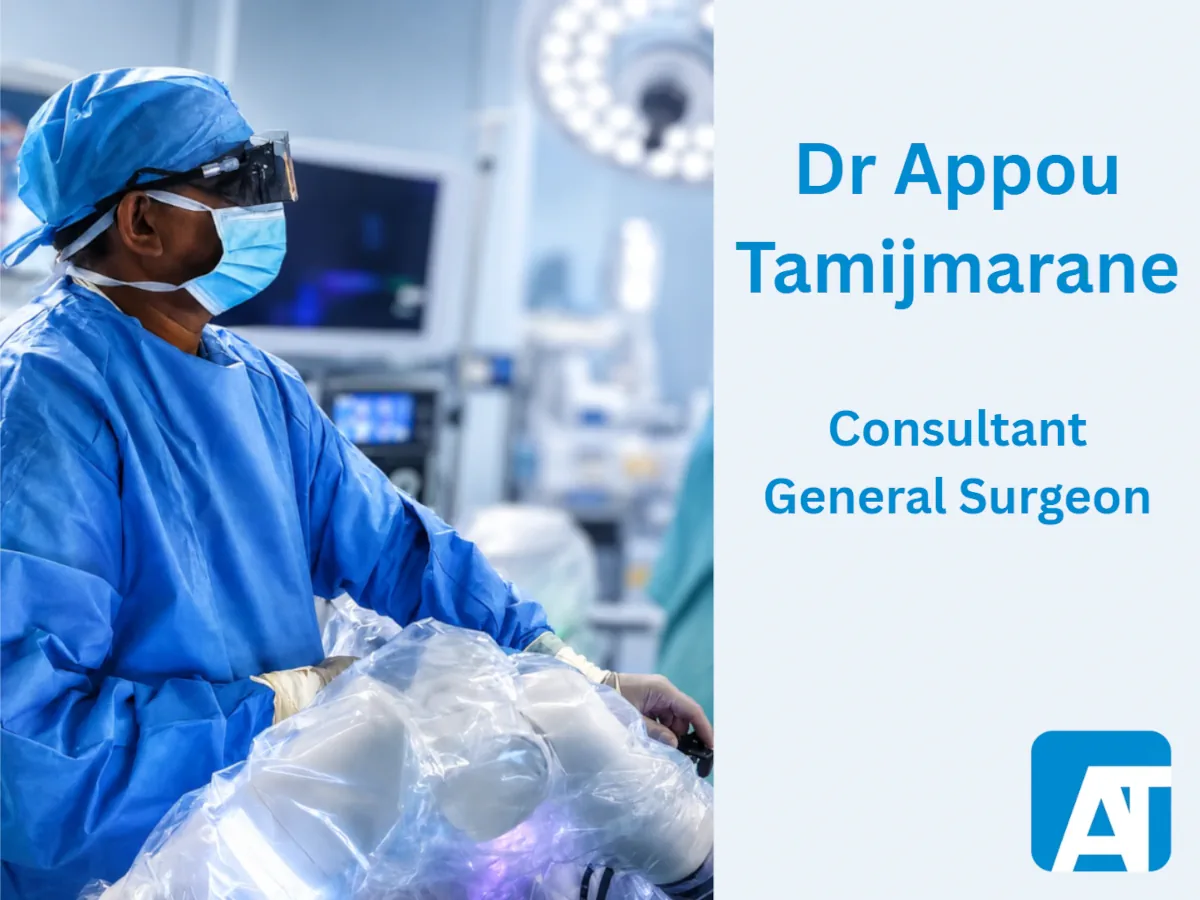
By Dr. Appou Tamijmarane | MBBS, MS (Gen Surg), FRCS (Edinburgh), FRCS (Glasgow), FRCS (Gen Surg), CCT
Consultant General Surgeon specialising in HPB, Upper GI, and Advanced Laparoscopic Surgery
Fakeeh University Hospital, Dubai Silicon Oasis | DHA License No: 50530660-001
Published: October 2025 | Last reviewed: November 2026 | Reading time: 7 minutes
Written for patients in Dubai who are choosing a general surgeon for general, laparoscopic or robotic surgery, and for the families who help them decide.
What a surgeon does · When to see a surgeon · What to look for · Your first consultation · What I offer · Making your decision · FAQs
Key Takeaways
Choosing a general surgeon in Dubai starts with three checks: a valid DHA licence with the right title, recognised postgraduate surgical training, and real experience of your condition. Dr. Appou Tamijmarane is a UK-trained Consultant General Surgeon at Fakeeh University Hospital, Dubai Silicon Oasis.
When a patient comes to see me for the first time, they have usually already spent time searching online for answers about their symptoms, reading about the procedure they think they need, and trying to find the right surgeon. That last question is often the hardest one to answer. I have been a surgeon for over 35 years, 18 of them as a Consultant in the NHS in the UK, and I now practise at Fakeeh University Hospital in Dubai Silicon Oasis. In this guide, I answer, honestly and directly, the questions I hear most often from patients who are trying to make that decision.
On this page
A consultant general surgeon diagnoses and operates on conditions of the abdomen and digestive system, and most also have a specialist interest.
General surgery is a broader specialty than the name suggests. It covers gallbladder disease, appendicitis, hernias, acid reflux and hiatus hernia, colorectal conditions, and skin and soft tissue lumps, as well as more complex operations within each surgeon’s specialist interest. My own specialist interests are Upper Gastrointestinal (Upper GI) surgery and Hepato-Pancreato-Biliary (HPB) surgery, which cover the liver, pancreas, bile ducts, stomach and oesophagus.
In my practice, I perform the full range of general and laparoscopic surgery alongside HPB surgery, upper GI surgery, robotic procedures and laser anorectal surgery. I also perform diagnostic and therapeutic endoscopies, including ERCP for bile duct stones. Patients often arrive with an idea of what is causing their symptoms, only for tests to show a different or more complex underlying condition. That is why experience across a wide range of surgical conditions matters, not just in the procedure you think you need.
See a surgeon promptly if you have any of the symptoms below, rather than continuing to manage them yourself.
Patients often come to me after weeks or months of symptoms they have managed themselves, or after a referral from their GP. These are the symptoms that should prompt a surgical consultation: [2]
Go to an emergency department straight away if you have:
If any of the symptoms above apply to you, an early consultation with an experienced general surgeon will give you a clearer picture and, in many cases, peace of mind.
Check the surgeon’s DHA licence and title, their postgraduate training, their experience of your condition, the hospital behind them, and how clearly they explain things.
Dubai has a large and varied surgical workforce. Here is what I would look for if I were advising a member of my own family.
Every surgeon practising in Dubai must hold a valid licence from the Dubai Health Authority (DHA), and you can check any surgeon’s licence on the DHA Sheryan directory. [4] Check that the title on the licence, Consultant, Senior Specialist or Specialist, matches how the surgeon presents themselves. The title reflects the DHA’s assessment of the surgeon’s training and experience, and it matters.
I am licensed by the Dubai Health Authority as a Consultant General Surgeon (DHA License No: 50530660-001), and I practise at Fakeeh University Hospital, Dubai Silicon Oasis.
Surgical training varies a great deal between countries and institutions. In the UK, the Fellowship of the Royal Colleges of Surgeons (FRCS) marks completion of a structured, externally examined training programme in a surgical specialty. It is a demanding qualification, assessed independently of the hospital where the surgeon trained.
I hold three FRCS fellowships, from Edinburgh (1995), Glasgow (1996) and in General Surgery (2002), along with a Certificate of Completion of Training (CCT) in General Surgery from the UK. Together, these confirmed that I had the knowledge, skills and experience to practise as a Consultant Surgeon. I then worked for 18 years as a Consultant General Surgeon in the NHS at Raigmore Hospital in Inverness, managing both complex and routine surgical cases. Raigmore is one of the five cancer hospitals in Scotland. I have since moved to Fakeeh University Hospital in Dubai.
Look for a surgeon’s postgraduate qualifications on their profile and, if in doubt, check them with the institution that awarded them.
Research shows that, for some complex operations, surgeons who perform a procedure more often tend to have better results. [1] It is entirely reasonable to ask a surgeon how often they perform the procedure you need, and how often complications happen. A good surgeon will be glad to answer.
Range of experience matters too, particularly for complex or unusual cases. Managing cancer cases within a multidisciplinary team, performing emergency operations, and handling complex HPB surgery all build clinical judgement that reaches well beyond any single procedure.
Over the past two decades, laparoscopic (keyhole) surgery has transformed how most abdominal operations are performed. Smaller incisions usually mean less pain after surgery, a shorter hospital stay, a quicker return to normal activity and a lower risk of wound infection. Robotic-assisted surgery adds further precision in selected cases.
However, and this is important, the right surgical approach is always the one that is safest for your anatomy and condition, not the one that sounds most advanced. I perform laparoscopic, robotic and open surgery, and I choose the approach based on your clinical picture, your general health and your wishes. We make the plan together. It is always reasonable to ask a surgeon which approaches they offer, and why they recommend one for you.
“The right surgical approach is always the one that is safest for your specific anatomy and condition, not the one that sounds most advanced.”
Dr. Appou Tamijmarane
Successful surgery is a team effort. The outcome of a complex operation depends not only on the surgeon but on the anaesthetist, the nursing team, the intensive care unit, the radiology department and, for cancer cases, the multidisciplinary tumour board. At Fakeeh University Hospital, I work alongside a full surgical team with access to robotic platforms, advanced imaging and a dedicated intensive care unit. This matters, particularly for anything beyond a routine planned operation.
Clear communication is one of the things my patients mention most often in their feedback, and I take it seriously. A surgeon who explains your diagnosis in plain language, sets out your options including non-surgical ones, is honest about risks and recovery, and gives you time to ask questions is treating you as a partner in your care. If you leave any consultation still feeling unsure, it is reasonable to seek a second opinion. I actively encourage second opinions for any patient facing a major operation.
A thorough first consultation should leave you with a clear plan for tests and treatment, and answers to your questions.
It should include:
It should not be a short conversation. If you are being assessed for something complex, such as a liver lesion, unexplained jaundice, a hernia that has come back, or symptoms that might suggest cancer, you should leave with a clear diagnostic and management plan.
Write your questions down before you come. Bring any previous scan reports, blood test results or letters from other doctors. A family member is welcome if you wish: a second pair of ears during an important consultation is almost always helpful.
I offer general, laparoscopic, robotic, upper GI and HPB surgery at Fakeeh University Hospital, Dubai Silicon Oasis, in English or Tamil.
A summary of the conditions I treat and the procedures I perform is on my Treatment and Procedures page. In brief:
My qualifications are MBBS and MS (General Surgery) from JIPMER, India; FRCS from Edinburgh (1995) and Glasgow (1996); FRCS in General Surgery (2002); and a CCT in General Surgery, UK (2006). My training began in India, continued through specialist surgical units across England, Scotland and Wales, and continues here in Dubai. I was awarded the Norman Tanner Medal and Travelling Fellowship by the Royal Society of Medicine, which supported advanced cancer surgery training at the Shizuoka Cancer Center in Japan.
Take your time, check the surgeon’s credentials, and ask every question you need answered.
Choosing a surgeon is a significant decision, and I would never suggest you make it quickly. Research the surgeon’s credentials, read their patient reviews, check their DHA licence, and ask whatever questions you need answered at the consultation. If something does not feel right, trust that instinct and get a second opinion.
What I can tell you from 35 years of surgical practice is this: the patients who do best are the ones who are well informed, who ask questions, and who are genuinely involved in decisions about their care. My job is to give you the clinical expertise and honest guidance to make that possible.
To book a consultation, use the Okadoc booking system or call the Fakeeh University Hospital booking line on +971 4 414 4444. If you would like to speak with me before booking, you can message me on WhatsApp or email me.
In summary
References
The figures on this page are drawn from international clinical guidelines and peer-reviewed studies, listed in the references above. Your own risks and options will be discussed with you at your consultation.
What a surgeon does · When to see a surgeon · What to look for · Your first consultation · What I offer · Making your decision · FAQs
Medical Disclaimer
This article is for general education and does not replace medical advice, diagnosis or treatment. Individual surgical decisions must be made with a qualified healthcare professional after a full clinical assessment. If you have any of the symptoms described in this article, please see a doctor promptly, and seek emergency care for the warning signs above. Dr. Appou Tamijmarane is licensed by the Dubai Health Authority (DHA License No: 50530660-001) and practises as a Consultant General Surgeon at Fakeeh University Hospital, Dubai Silicon Oasis, UAE. Patient testimonials referenced elsewhere on this website are published with consent.